Monday, January 24, 2011

UFO's and J boats at the same time.

There is a reason RIBs (Ridged Inflatable Boats) are favored by search and rescue organisations. Fast draining, lots of flotation, lightweight, and can handle low impact collisions with no problems. But look at this elegant version of the sturdy RIB. Add beautiful lines, a carbon fiber hull, and lots of amenities and you have a UFO 69. The one you are looking at is the only one in the US, so I am thinking not a lot of people have seen this vessel. RIB pleasure craft have been popular in Europe for a long time because of the fuel savings, and this sleek vessel should alter your perspective of an RIB being more than a stodgy, and wet, hard riding dingy.


This UFO 69 (23') is commodious, and packed with lots of nice features. A Garmin 4208 chart plotter, and sounder module, ICOM VHF, lots of seating, and real teak decks. Add to this a thumping Fusion stereo with bazooka sub-woofer, refrigerator, blue OceanLED underwater lights, and there is even a wakeboard hook. In sum, it's both a terrific fishing platform, and an elegant day cruiser all in one. It looks fast sitting still, cruises at 35mph, and has a top end of 53mph, and this is all done with a single Honda 225hp 4 stroke. With the speed of twin engines, coupled with the fuel economy of a single engine, it's no wonder why they are so popular in Europe.


The aft of the boat has an open transom for quick draining, and a telescoping swim ladder is under the port side of the transom. If you look closely, you can see the fresh water shower system also on the port side.


The hull is carbon fiber epoxy with  a tunnel, and there are two steps built into it. If you look at the first picture at the top, what appears to be black on the hull is actually clear coated carbon fiber. Gorgeous to the eye, but very hard for me to get a decent picture of. 
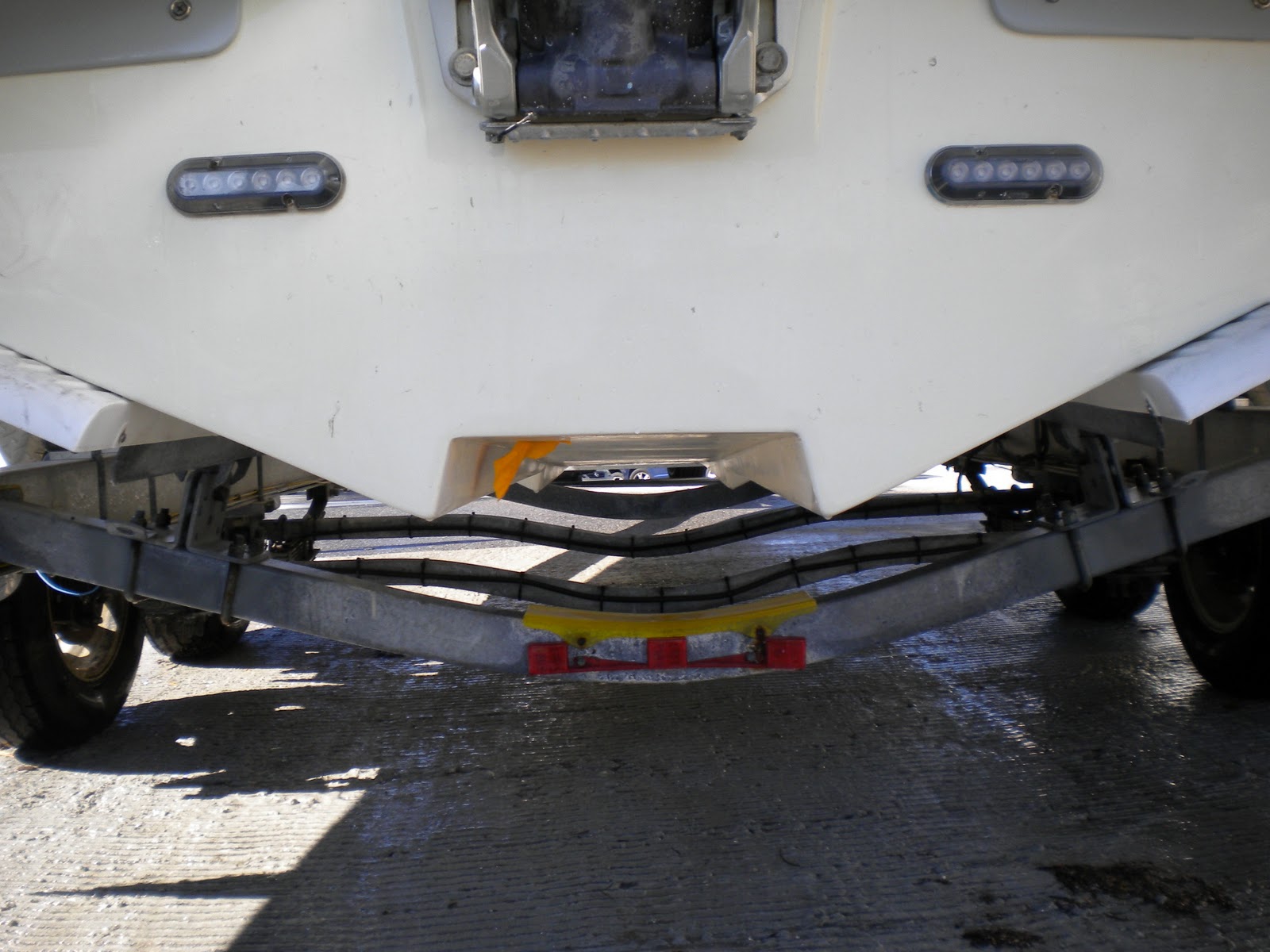


This is a picture of a hull in fabrication, I lifted from UFO Boat's website showing the tunnel and the steps formed into the hull.


There is yet another cool feature to talk about. Mounted under the helm seat is an inflation, and deflation system. The vessel has a beam of 10' 5", and in Florida, the maximum trailer-able width without a permit is 8' 5".


With a wide 10' 5" beam, the answer to this transport problem is you deflate the tubes with the vacuum system, and in just a couple of minutes they are sucked into the hull, and you're now legal to haul it on a trailer


All in all, I was most impressed, and I'm not easily impressed. Sleek, safe, fast, fuel efficient, loaded with toys, and a sticker price of about $100K. I know it sounds stiff, but compare it with the price of a new Boston Whaler of about the same length, and it looks very good to me.


Now for part two of the story. What would be the odds of finding two shiny new boats I had never seen, at the same place and time, with a full camera battery? This is hull #1 of J boat's new J/108 shoal draft cruiser line, although I kind of hate to call it a "Cruiser", because it screams performance to my eye. The cockpit is large, with an open transom, and it's set up for single handing, including raising, and lowering the centerboard. 


The first thing that jumps out at you is the twin rudder set up that not only allows you to turn on a dime, and give you back nine cents change, but also allows you to gracefully back down into a slip, without all the cursing, and frantic gyrations I have always been used to. To be honest, any attempt to back down my sailboat generally resulted in a frantic abort, and stuffing it into dock bow first. I'm envious.


The very J boat bow features a fixed sprit that will accommodate a second furling headsail, an integrated bow roller system, and anchor winch. Another detail I like about this craft is that there is something to really hang onto if you have to go forward to the bow, while things are rocking and rolling. 


Despite it's purposeful J boat lines, it really is a very comfortable, full feature cruiser with clean interior lines. It sports a large salon cabin with good headroom, large forward V-berth, and lots of teak trim.


A complete  gallery with lot of storage, refrigerator, two burner range, oven, and a double stainless steel sink.


A real navigation station (something that is now missing from so many boats today), and complete head round out the interior. Lots of ambient lighting, and light colors makes it a pleasant environment to be in.


But the thing that makes this performing cruiser noteworthy is the 3' 9" draft, with the centerboard up. With the twin rudders, and the centerboard up, it still points very well into the wind. If you're racing, you can lower the center board down from the cockpit, and you will pick up a few more degrees upwind. With the centerboard down, the draft increases to 6' 8".


So in the end, this is both a comfortable cruiser, and a true performance sailboat in one package. It is also a striking, and beautiful vessel to boot. It was like Christmas. Two unique vessels stumbled upon on the same day. Both of these boats were leaving for Key West last week, for "Race Week", and were being shown off at the Galleon. And many thanks to Craig Crossley for letting me take the pictures, he was in a hurry, and took the time to indulge me.

You can learn more about the UFO 69, and the J/108 at Cross Current Marine
The interior photos of the J/108 are from the Jboats website
The photo of the UFO 69 hull is from UFO Boats. Your browser should be able to translate it.

Tuesday, January 18, 2011

Cable ties, their true purpose uncovered?

Is it only me? Or is it just my imagination that this is the most dangerous thing on a boat. This insidious invention only appears to be a useful way of restraining wires. Its real purpose seems to be the collection of copious quantities of my DNA for some unknown, but no doubt Frankenstein-esque purpose. Why else would it have all of those sharp edges. It's bad enough that the cut off end is sharper than a razor blade, but even the small square body of the tie wrap has sharp enough corners to insure efficient collection of my flesh.


The rules say, you must cut off the ends, to make the installation look pretty, and to insure the next person who comes along will have their DNA amply  collected.


This picture is a typical example of the daily carnage this invention from Hades can cause. I have also observed that the more white leather and carpet there is in a boat, the deeper, and bloodier the scrapes from the cable ties are. How they know to do this, I don't know. Perhaps some form of advanced foreign nanotechnology is being used. 

Yes, I know they make a tool to cut off the tie ends flush, but it is one more giddy bob I have to carry around in a bag that weighs to much anyway, and often the tool is difficult, and awkward to use in very confined areas.


But worst of all is the danger to an unaware populous by this seemingly innocent tie wrap. For in reality it is a truly dangerous device. The scientists at the top secret Parmain laboratory have analyzed the potential threat these so called "Cable Ties" pose to the unknowing public, and we were horrified when we uncovered, the "Shiv Ring". This dagger of death is hard to see with an x-ray machine, very sharp, and could slash open up your carotid artery in an instant. We have sent telegrams to the TSA, and prison wardens to alert them to this clear and present danger. Citizens should be on guard, and report any suspicious tie wrap purchase activities immediately to the authorities. There has to be a better way.

Monday, January 17, 2011

Buzzzzzzzzzzzzzzzzzzzzzzzzzzzzzzzz

The droning, the incessant buzzing. It never stops. Day in, and day out it's alway there, burrowing through my ears, and into my head It's driving me crazy. Oh please, I beg you, make it stop. My fevered brain searches for a solution. Wait a second, gasoline, and lots of it, I'll burn them out, no, no, dynamite, that will do the trick, uh yes Kate? I didn't hear you. No, I haven't called the beekeeper, but I will do it right now.


Meet Kevin Lausman, an apiologist, and master beekeeper. Here is my problem. A hive of bees has moved into a small boxed in section of my bedroom ceiling almost directly above the bed, and they have been busy. You can hear the droning, and it is time for them to go, permanently. Kevin, and his "in training" associate Tory Uccello are going to do this sweet job. Their goal is to capture the bees, and to relocate them to a new home, which will be located some place other than my bedroom ceiling, far away.


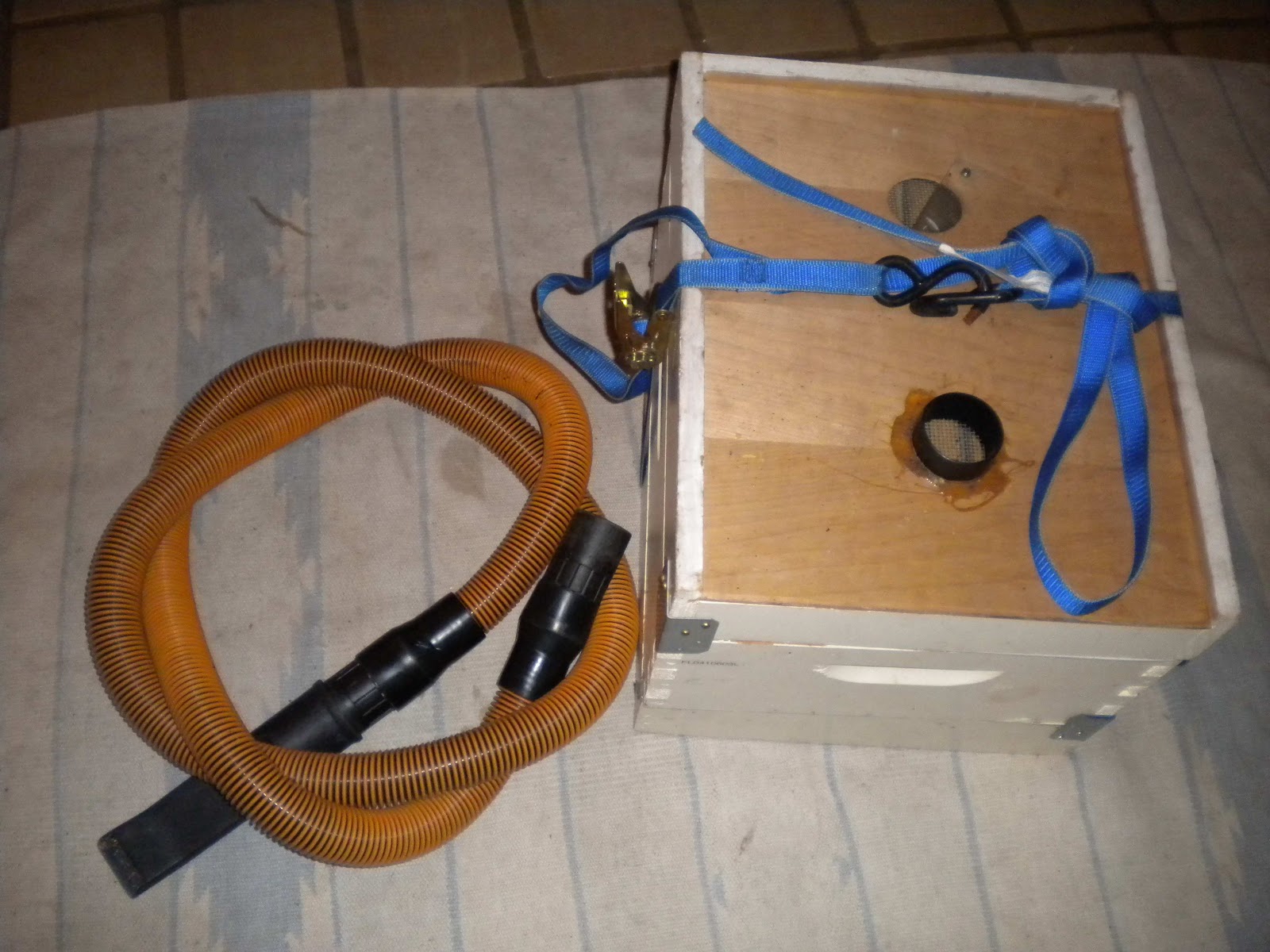
I know there is a tool for every job, but my horizons have been expanded, after being introduced to the bee vacuum cleaner. A shop vac hose plugs into the top of the box, and the bee collection hose plugs into the bottom side of the box. Inside is a mesh screen that the bees can't get through. They get sucked up, and end up in the box without being hurt.


The process of hive removal is fairly straight forward. Using a stethoscope, and a laser thermometer, Kevin quickly sizes up where the hive is, and and starts to cut a hole by the back of the hive. The reason for this is that the more aggressive guard bees are at the entrance of the hive.  


A little smoke is wafted into the hive to help quiet them down, and the hole is enlarged enough to do the extraction.


And there is the hive, looking like something out of the movie "Alien". It actually extends further back (or down in the picture). It was in an area about 18" x 2'  and about 10" deep.


Tarps have been laid down, and Kevin takes a knife, and going from back, to front, starts to cut out the combs. As he does so, there are bees covering the combs, and Tory vacuums the bees off. As the combs are being cut away, Kevin is sorting them. The honey combs go into one bucket, and the combs containing bees in progress, and other things, I guess, go into another. This continues until all of the combs are removed. The amazing thing about this is I'm standing within a couple feet of all this, with no bee suit, and they didn't bother, or sting me at all.

After the combs are removed, Kevin sprays an almond smelling solution in the space that won't hurt the bees, but keeps them away from the hive remains. The bees that were flying around loose in the room all migrated to the light from the windows, and they were vacuumed up off the screens. In about four hours, about 15,000 bees were caught, and will go to a new hive, where they will do hard, but useful labor for the rest of their life. The queen's hive was found, but no queen was seen, although she might have been vacuumed already, or according to Kevin, the hive may have recently swarmed.

I was left with about 15 lbs of honey comb, and instructions on how the extract the honey. The last part of this exercise was to at least temporarily close the hole. I did this with a piece of smoked plastic from a Searay remodel, although looking at Kate's face when she saw it, I instantly realized that opaque anything would have been a better marital solution. I will tape some paper over it. Expanding foam was used to fill the entrance crack on the outside of the house.


The boating tie in is that Kevin removed a hive from a trailered catamaran last week. In this case, the bees were using the transom drain hole as an entrance, and it was fortunate that there was an access plate in the hull to allow hive removal. The problem with this type of infestation, is the hive must be removed, or malodorous things will happen. Dead bees, lots of honey, and wax will result in a bunch of other things moving in to dine on the rotting feast.

There was a scenario where I could have killed the bees with insecticide, and theoretically removed the bees, and hive myself, but Kevin's solution of saving the bees, wax, and honey was more elegant, educational, and very satisfying. This is a job best left to experts, with bee suits. When Kevin first looked at the problem, we were standing outside the house, looking at the bees come and go from the entrance, and I asked him if the bees were africanized. He grinned and said no, because if they were, we would have already been "tagged". I have already discussed rats in boats, and at some point in the future it will be the Black Widow spiders and wasps turn. So much pestilence, so little time, especially when you live in Florida.  

Bees are important, and useful little insects. They play a critical, and important environmental role in the pollination a huge variety of plants, and crops, and their role can't  be replaced by human effort. You can learn more about the role of bees in our lives below.


Kevin Lausman, master beekeeper can be reached at Suncoastbeekeeper@verizon.net


Tuesday, January 11, 2011

Death revealed in the bilge

Sherlock Holmes said, "When you have eliminated the impossible, what ever remains, however improbable, must be the truth." This is part II of Death hides in the bilge, and we will apply Mr. Holmes' logic to this discussion.

Let's start with a base line. These four batteries, are arranged as two pairs of 12 volt batteries wired together in series, then the two pairs are wired in parallel together to make one 24 volt bank. The 24 volt positive input from the charging systems goes to one pair, and the ground is on the other pair. It is wired as it should be.


The batteries were about two years old, and are used as the house bank. There is another identical battery bank that is used for engine starting. 


This is what we know. The batteries had been checked a week earlier, and were full of water. The batteries boiled out, creating a lot of hydrogen sulfide gas, and had become toasted into oblivion when they were looked at a week later. The batteries were replaced, and the cores were disposed of before any forensic analysis could occur. Four new batteries were installed, and the system is now operating normally. The charger voltage output to the batteries is as expected, and the temperature sensor is operating correctly. So the trick here is to try to develop a scenario in which this could have happened.

In general, the way battery chargers work, is they measure the voltage of the battery in between charge pulses, and adjust their output voltage accordingly. The lower the voltage in the battery, the harder (more voltage) the charger works to charge it. If the battery is fully charged, the charger just puts a little bit of current into it to maintain the charge. The actual technique is more sophisticated, but this is basically what is going on. Your alternator is doing the same thing. Now for the geeky stuff. The average 12 volt battery is made up of 6 cells, each of which generates 2.1 volts. These are connected in series in the battery case. So 6 times 2.1 volts equals 12.6 volts, and voila, you now know how your boat battery is put together.

Okay, lets take a scenario where one of the cells gets shorted. The battery will still work, but now instead of having six operating cells, it now has five, and the fully charged battery voltage is now 10.4 volts. To the charger, it now looks like it needs serious charging, and it cranks up the current. The reality is that the battery is at full charge, and pumping in extra current, when it is not needed causes the battery to heat up. The extra heat starts to evaporate the water at a faster rate, and the plates in the battery get exposed. When the plates get exposed, the hydrogen gas combines with the sulphates on the plates, and bad gases are made. By the way, these gases are why you see that white or blue stuff growing on your battery terminals, and a sign that something is going awry.

So what's the safety back up? The answer is the temperature sensor. In this case, if the temperature sensor reached 140 degrees, the charger should have shut off, and it eventually did, but it took a while for this to happen. There could be several reasons for this. If the sensor was not making good contact with the surface of the battery, it wouldn't provide an accurate reading, meaning the reading would be lower than the battery's real temperature. I have seen these sensors pushed into blobs of silicone goo, and the goo insulates the sensor from the battery if you use too much. The other thing that could have happened, is the sensor was not attached to the battery that actually shorted in the bank. It could have taken some time for the non-shorted batteries, to finally get hot enough to trigger the sensor. In the end, extended overcharging of batteries creates heat that boils the water away, causes a battery's early demise, and creates explosive gases.

So in the end, the problem was caused by a shorted battery, in the engine room, with a poorly attached temperature sensor, or one that was not on the shorted battery, or both. Colonel Mustard gets off the hook, this time. When you look again, at the second picture, the temperature sensor is now straddling, and glued to two of the batteries in the bank, and is additionally pined down in place by a battery jumper cable. This insures good contact, and now two of the four batteries are being measured.

I have to admit that this was an unusual, but not that unusual of an event. Batteries can be dangerous if not properly cared for, and even if you do, sometimes bad things can still just happen.  So here is some advice from the Installer:

I think AGM (Absorbed Glass Mat) batteries are better options for a boat than the lead acid versions. They are much less prone to out gassing, and cell shorting. Both can happen, but but it is much less likely. They also do not require water, so if your batteries are in a location where it is hard to fill them, human nature says they won't get checked, or filled as often. 

If you smell "Rotten Egg" gas, leave the boat immediately if you can, and turn off the engines if they are running. Shut off the battery charger, by throwing the shore power breakers, and allow plenty of time for the gas to dissipate. Remember the rotten egg smelling gas is very explosive, and very poisonous.

Allow gas to dissipate before re-boarding. Turn off all DC/AC power breakers, and battery switches prior to dealing with the batteries to reduce ignition risk.

When changing out damaged batteries, wear safety glasses, and take off that long gold chain with the Atocha coin, and any jewelry that could cause a short.

I view lead acid batteries with some suspicion after two years on a boat. I know they can last much longer, if properly used, and charged, but I would load test them at two years old or so, to see how they are doing, and then yearly after that.

And I just want to mention, showing an abundance of caution, that on the vast majority of boats, it is a bad idea to run the battery charger via the generator, and engines at the same time. Each charging system can fool each other, and unpredictable things can, and will most likely happen.

Batteries are heavy, powerful, full of dangerous chemicals, and require sobriety, and respect when you deal with them.

Some humorous thoughts about batteries, and chargers from "Bruce the Surly" 

Saturday, January 8, 2011

This is all your fault

It has come to the Installer's attention, that according to the social media mavens, twitterati, and Youtubeologists, that the written word has become passe, and you can't possibly have a good blog on the Internet that just uses old fashion words, and pictures. Apparently, according to the experts, the world has changed, andthe attention span of the public has shrunk to 14o characters. Content must be literature light, with few words, and preferably small ones at that. Maybe they are right, and I am a little out of date, or a lot out of date. So in the spirit of being hip, and having almost the web capabilities of a 58 year old, I created a little boating related Xtrnormal video which is now posted on Youtube.


 Here is the link to It is all your fault, you sunk the boat

So take that you mavens, and nattering nabobs of online content, "The Marine Installers Rant" is now sporting an online media format. Oh, and wait, is there a tweet coming in? Why yes. No doubt it is a 140 character message of great import, and here it is: "DRINK OVALTINE". Ralphie was disappointed too.

Actually I did spend the morning putting a Facebook page together for the blog, and as soon as I figure out to link to it, I will. The little cartoon was fun to make, and I will do it again, but unless I change my name to Ashton Kutcher, "No tweets for you". I love the printed word, and I'm not giving up on it.

C'est la vie

Sunday, January 2, 2011

West Marine grand opening fun in Sarasota

The grand opening of the new West Marine Flagship store a couple weeks ago in Sarasota was quite the production number, and is close as we will have to a real boat show this upcoming year. Their large parking lot was overflowing with boats of all types. This included Boston Whalers, Andros Boatworks, "Panga" style center console fishing boats, Searays, and many others.


The Team Donzi Yellowfin was impossible to miss, and as you might imagine, it is a poster child for Simrad's full product line. Simrad also had a table top display in the store with sales staff to chat with.


Raymarine, and Mastervolt brought in their mobile showrooms, with a full complement of staff. Garmin, Standard Horizon, and many other electronics, and product vendors had staff present also.


Since I grumble occasionally about fishing boats that never seem to be up to the tasks they are sold to do, I was tickled to see this Andros Boatworks vessel, that had enough rod holders to satisfy even the most demanding fishermen. I started to count them, and gave up after 60. If you put a rod into each one, this boat would look like a sea urchin.


I couldn't resist putting in this picture of the new Power Pole shallow water anchoring system. It's so cyborg, and sci-fi looking. I could imagine adding another degree of freedom to each side, throw in some simple controls, and having it walk you across the flats. I think it's a novel idea. You just can't take the robot perspective out of me.


Because I can, I am giving this salty little vessel, a Ranger Tugs R21 the "Best in Show" award. A two foot draft, huge aft cockpit, and enough amenities to spend the night out. I don't think I would want to take this little vessel on a Great Loop trip, but for local excursions, and day trips in SW Florida, its perfect. I would however take their R29 on a Great Loop trip in a heartbeat. Good quality construction, efficient layout, and a diesel engine that just sips fuel. They are built in Kent Washington, and the company has been around since 1958. You can learn more about Ranger Tugs here.  The Sarasota area dealer is Gulf Island Sails.


And now to the highlight of the whole grand opening event. West Marine sponsored a "Casting for a Cause" charity benefit, and this was huge fun. Tickets were ten dollars, and included adult beverages, and lots of excellent food. There was live music, silent auctions, raffles, many marine equipment technical representatives, and lots of other activities. The event answered that question that has been pondered by many a sage, and that is "How many people can you fit into a West Marine flagship store?", and the answer is well over a thousand. To be honest, it was a thousand over a three hour period, but the store was seriously packed.


West Marine's CEO Geoff Eisenberg, and Port Supply's Jim Bandy were personally greeting guests at the front door. Geoff is indeed a very gracious, and pleasant person to talk to. You too Jim, but I see you regularly.


Gecko's Grill and Pub provided the catering, and below are Lia Santos, and Byron Diamond tending to the adult beverages. Gecko's is my favorite local watering hole, and at two blocks from my house, it is geographically very attractive, and has been for over 16 years.


Hors d'oeuvre stations were set up at various locations throughout the store, including a seared tuna carving station, my personal favorite. 


In the picture below, you can see the infamous "Deadliest Installer" in the center. On my left is Travis Lofland, deck hand on the Wizard, and on my right is Edgar Hansen, deck boss, and engineer on the Northwestern. Both of these "Deadliest Catchers" had to stand in a long line to get their picture taken with me, because hundreds of attractive women heard I was there. Ha, I wish. I wouldn't survive one day doing their job on a cold Bering Sea day, but I don't think they would like mine on a stinking hot August day in Florida either. 


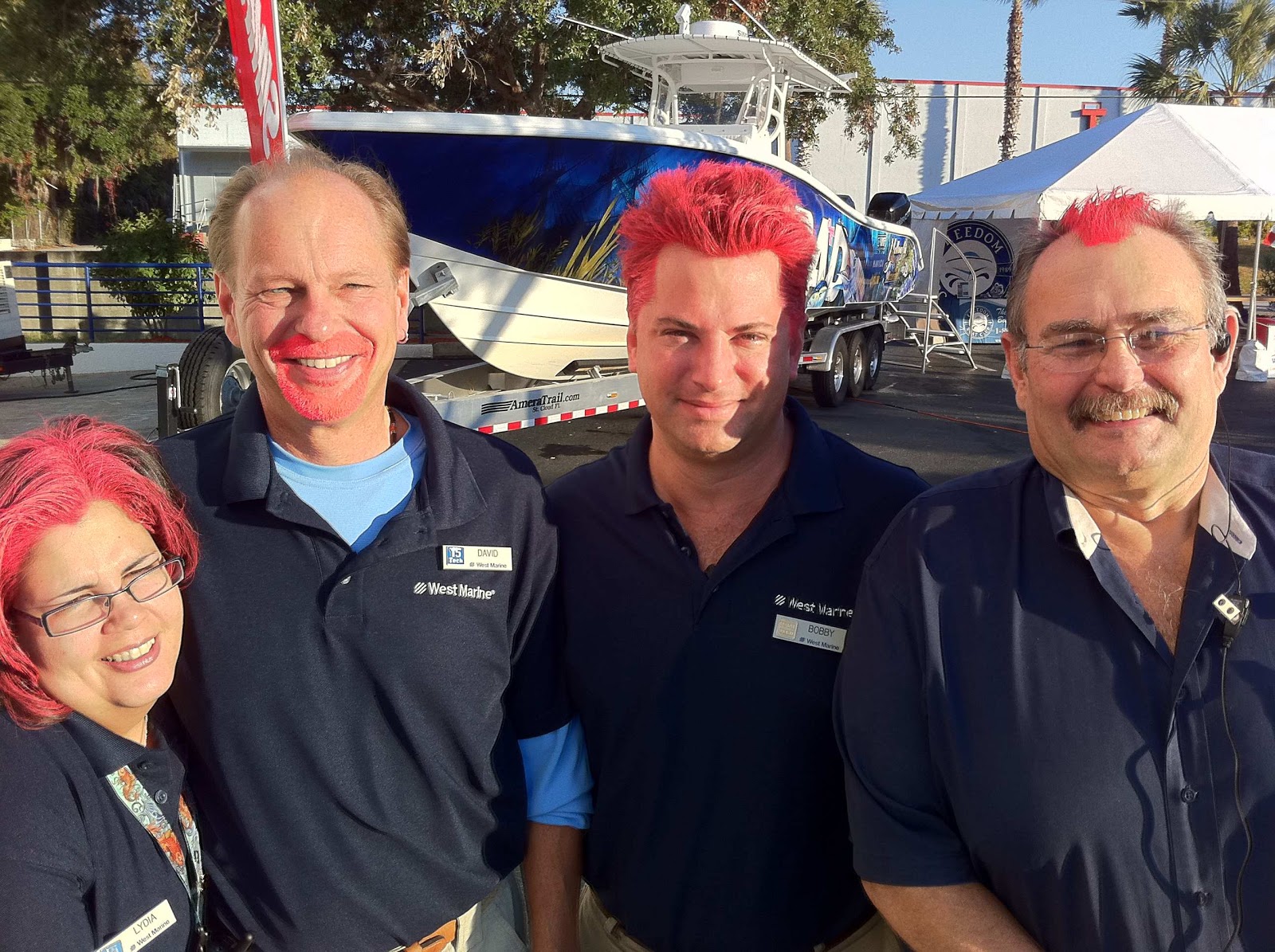
 Prior to the grand opening, there was a large store staff meeting, to get everybody pumped up, to meet the grand opening sales goals. As you might expect, some employee wanted to know what he would get if the store made its goal, and then apparently someone else suggested that management should shave their heads, if they made goal. As you can see the goal was made, and fortunately a compromise was negotiated. I have it on good fashion authority, that "Pink" is the new "Black", and any scuffed up, boat shoe wearing marine installer knows this. From left to right are assistant managers Lydia Diaz, and David Plank, followed by district manager Bobby Greenwell, and general manager Wayne Seel, all temporarily pretty in pink. 


So the store empties, and captain Bob Nichols is seen with a dust mop, cleaning up after all of the reverie is over. I liked the picture. It reminds of the the little guy that used a broom to sweep up after Fractured Fairy Tales was over, on the Bullwinkle and Rocky cartoons.


The real purpose of the event was to help our local charities out, and it was a great success. Over $18,000 was raised in the three hour event, and the majority went to supporting youth sailing, and children's needs programs in the community. Nothing is better than having fun while you're helping others.


Below are the links to the charities, and thanks for making it possible West Marine.

Casting for a Cause
Sarasota Youth Sailing Program
Englewood Youth Sailing Program
Mote Marine Laboratory
Suncoast Charities for Children
Sarasota Yacht Club Charitable Foundation
The Snook Foundation
Sarasota Bay Watch
Sarasota Power Squadron

Thursday, December 30, 2010

What the installer wants for the new year.

The phone rings, and I answer the call. It's Bob, "Hi Bob, what's up. You're in the Bahamas with your family? Sounds nice. Your grandson accidentally changed the Garmin chart plotter's language to one you can't read? Calm down Bob, we can fix up the little urchin's faux pas in short order. You have your waypoints backed up like I suggested don't you? You forgot? Okay we can still fix things up, no worries. Okay Bob, no matter what it now says, touch the small button in the very upper left corner of the screen. Did a bunch of big blue buttons appear? Good deal Bob, now look at the big blue buttons. See the one with the gears on it? Touch it, and don't touch anything else. Let me think about this for a second. Touch the second button down on the blue button list at right, that should be Preferences, I think. Now touch the second blue button down again on the new list. Good, do you see English, or Americanized English on any of the buttons, either will do. Yes? Excellent touch it. Can you read it now? You're welcome Bob, keep the kids, away from the nav gear, and don't forget to back up your waypoints. The little tyke could have done a factory reset, and then you would really be in a jam."


I do this sort of support often, and I am pretty good at it, to a point. If I have to go any deeper into the menu trees, the dialog starts to have a lot of, "Okay Bob, read me the list you see. Good, now touch "device list".

I was really excited when I saw the Garmin chart plotter simulator you see below. Boy would this make my life easier. I could actually see what the client sees, when I have to do this sort of remote diagnostics. I was ready to download it on my "murse" (it's Kate's word for a man purse, my net book with all of my nav update software, pdf manuals, and cables), But I have to pull up on the reins. It works perfectly, with a terrific format, but only for a couple of layers down, and then it just stops. I think this could be a great tool, both from a support viewpoint, but also an excellent training aid. And it would be good, at least for me, if everybody developed a version of this, for their larger and more complex systems, and I'm now also musing out loud to Raymarine, Navico, Furuno, and all of the others in this line of endeavor. This is a grand idea.


Now on to chart plotter cable plugs, and boat builders. As the navigation systems have become faster, and do more things, they have gotten larger, and deeper. This coupled with the plugs, which sometimes to me, looks like my modestly exaggerated example of a chart plotter's power plug shown below can make installations difficult. 


So first the boat builders. I am still amazed at the lack of forethought I see in many helm layouts. Sure they look pretty, but why didn't you think, after the customer spent $100,000 on the boat, he would only want to install a chartplotter with a 4" screen, because that's all you left room for. Sometimes they look big, but behind them, all too often there is not a lot of depth, which can require all sorts of gyrations to get systems to fit, if at all. While I am on this subject, I want to remind all boat builders, that modern navigation systems require wires, and sometimes lots of them, coming from various places on the boat, so ponder on that when you do your next design. "I want to say one word to you. Just one word. Conduits." (sorry Mrs Robinson). And as long I'm ranting, this business of building a "Fishing" boat that has an anchor locker design you can't install a winch on has got to stop. Are the people that make that orange ball paying you to do this?

For the chart plotter manufacturers, I know there is a ton of wiring that that has to go to your systems, and that things need to be water resistant, but as your systems get deeper, look for ways to keep the plugs from exacerbating the problems, and dimensional drawings of the equipment should also reflect the depth needed with the plugs. 

My final wish is that everybody has a safe and prosperous new year, and steer small damn your eyes. 


Monday, December 20, 2010

An unfortunate series of electrical events

Sometimes, even if every rule, and guideline is followed, the great electrical gods can play a prank, if only to demonstrate their omnipotent powers, and faithful adherence to Murphy's laws. A local captain asked me to look at what happened here, and offer any opinion I might have about it, and as you might suspect, I have one, or two, at least. That round stainless steel fitting you see in the picture holds a flat panel TV in place on the bridge. The TV was stored below, and the owners were out of town when this minor conflagration occurred. 


This event had a simple explanation, and it didn't take a rocket scientist to figure it out. Below you can see the power plug for the TV has melted into the split loom that was covering the TV's coax cable. The plug shorted internally, and started to catch fire, sort of. A lot of smoldering, smoke, and heat was going on, but I suspect there was no flame.


There was little if any of the plug left to forensically examine, but there was a void in the center, where the wires would have attached to the pins. My guess, and that is all it is, was when the plug was molded, there were a few strands of loose wire that were in close proximity to each other, and over time, with the help of a little heating, they eventually came into contact with each other. The plug's circuit was still live when I looked at it, so whatever had been shorting in the plug, had stopped, and no real fire started. The fiberglass was charred, and there was enough heat to do some minor damage to the Isen glass above it.


Although the TV's power cord is toast, in a literal way, the cable TV's coax cable can be fixed by splicing in, out of sight, a new piece of cable. Although in this particular, and peculiar case, I think the split loom was being used in a cosmetic way, since the wiring is visible, but it actually ended up saving the day. I will come back to the split loom a little later. 


The fact that the circuit was still energized was curious to me, especially given all of the arcing, and sparking that had to have occurred. I didn't use any fancy equipment to detect this, I just used my keen powers of observation to note the DVD player was still on under the cabinet, so off I went to do a little exploring. I found the GFCI (Ground Fault Circuit Interrupter) for this circuit in the head, and at first blush it looked normal. I wasn't surprised the GCFI hadn't popped, it wouldn't have in this case. Why? After the events on the, bridge you might think so, but in theory, it was doing its job, which is to detect current imbalances in-between the hot wire, and the neutral wire.

If an imbalance in-between the neutral, and hot wire occurs, the presumption is that some electricity is going somewhere else, like through you.

Let's say you're in the bath tub, perusing the latest edition of Wooden Boat, and a cat jumps up onto the counter, and pushes the plugged in hair dryer into the water, as cats are oft prone to do. Since some current is now flowing through the water, and you, there is now a current differential. The GFCI, in about 1/30th of a second, senses the imbalance has exceed about 5 milliamps (enough to feel a tingle in fresh water), and disconnects the circuit, and thus thwarting the devious cat's latest attempt at your demise.

Although the GFCI looked normal, with its happy green light glowing, it was broken. The trip mechanism was faulty, and it needs to be replaced. GCFI's should be checked periodically, by using the test button on the receptacle, and reseting it. The indicator light should turn off, and then come back on when reset. If there is not a light on the receptacle, plug a lamp, or the ilk into it to test it. If it's faulty, replace it soonest.

As a small note, according to a study by the American Society of Home Inspectors, around 20 percent of GFCI's tested are faulty, and in South West Florida, due to lightning, and the associated electrical transients, the number is closer to 50 percent, so test early and often.

The circuit breaker on the main panel didn't blow either. The short wasn't drawing enough current to trip it. 


I have pondered whether things might have been worse, and the answer is yes. I mentioned before that I thought the split loom was just being used to dress up some exposed wiring, and in this case it saved the day. If the split loom had not been on the wires, a real fire may have started. Just to verify this, I set up this little experiment in the top secret Parmain laboratory, to see if I could get split loom to catch on fire. 


I hung some split loom up, (Ancor marine grade), and using a high tech incendiary ignition device, I lit it. Sure enough, it started to burn, sort of, but just for a few seconds, and then the flame went out. 


It really only continued to burn, if the flame source was present. Take away the flame, and it self extinguishes, just as its label says. Another empirical lesson learned in this little experiment is to not let melted drops of this stuff fall on your hand. It's not pleasant, Doh! 


As I said in the beginning, even if everything is to code, and properly installed, the wrathful electricity gods can still play havoc with your vessel, sometimes just because they can. I suggest that at least once a year you maybe consider sacrificing a small lamp or hair dryer to the gods.

If your cat is still trying to kill you, a couple of rescued Greyhounds around the house will help. These "Coiled Springs" will keep the cats at bay at all times. Greyhounds are gentle, fun, devoted, and graceful dogs, that are always appreciative of a good home.


Greyhound rescue groups are found all over the US, this is our local one.

Sunday, December 12, 2010

Tech support Kudos 2010


"The Installer shall from time to time give to boaters information of the state of marine electronics technical support, and recommend to their consideration such measures as he shall judge necessary and expedient".

Ladies and gentlemen, and fellow boaters, I want to aver that the state of boating technical support is strong. Okay, enough of this falderal, it's that time of year to provide my assessment of marine electronics technical support. I have changed the format a bit this year, and what I will do is acknowledge the better technical support efforts I have encountered this year.

As smart as I think I might be, it is comforting to know that there are much smarter technical professionals out there to help. I think that at most times, it must be a very gratifying job helping boaters solve their problems. Although, on occasion, I'm sure that they would like to reach through the phone, and slowly choke the caller that is either rude, or is just trying to suck the living soul out of them. I just hope I'm not one of them, most of the time anyway.

I am going to start with Raymarine and give them kudos for being the "Best of the best". Short phone waits, if any. Excellent and very knowledgeable personnel who are always helpful. They provide superior support, and information in a friendly, and professional way. Thanks Mark, Trevor, Linda, and the rest of their team for teaching me something on every call.

Garmin gets the "Most improved technical support" kudos. The wait times have shrunk dramatically over the previous year, and I now often get in immediately, without a wait. I also like the fact that you collect my phone number when I call, because on more than one occasion, my cranky cell phone provider, drops my call, and I have gotten an immediate call back from the tech. The tech support staff also sounds less scripted this year, and there were fewer incidents of being put on hold because they needed to ask the help desk something. Good job Garmin, and very much improved.

There are two "Above, and beyond the call of duty" kudos this year. The first goes to Josh Weltman at Nobletec Navigation who spent many hours over several weeks, helping me sort out Nobletec software issues after some shamans "Fixed" the PC computer system on a boat. He was patient, knew what he was talking about, and if he didn't immediately know the answer, he found out, and called me back. Thanks Josh, you were a lifesaver.

The second kudos in this category goes to Allison at Garmin who persisted mightily in helping me solve a somewhat odd sounder module related problem. Allison has assisted me several times, and alway does an excellent job, Thank you Allison.

Other notable kudos go to:

Airmar/Gemeco for always being helpful and pleasant to deal with, and assisting me in figuring out which of a zillion wiring diagrams I should be looking at. And thanks Irene for the help with the WeatherCaster port business (the same shamans from above at work here).

Teleflex has continued to provide great support, and good advice. Nobody knows marine hydraulics better than Marc Adams, and Teleflex.

Navico has done an excellent job, especially when you consider the bewildering number of brands they deal with. I spoke recently with a tech I have dealt with for years on Northstar problems, who seamlessly helped me with a Simrad autopilot issue. Good job Bill, and Navico.

For everybody else, I'm not ignoring you, there are just too many, but all have done a good job. I can only think of a couple of occasions this year when I was little dissatisfied with the support, and I'm writing the incidents off as one, or the other of us, was just having a grumpy day.

So I want to remind everybody that this is a complicated world, and the technical support groups all try their very best to help you solve a myriad of disparate, and complex problems on a daily basis. So don't forget to say thank you. I'm sure they don't mind hearing it. If you see a hand coming out of your phone, drop it and run, and don't ever call back. Your being a jerk!

The "shamans" mentioned above were involved in an earlier story titled PC Purgatory Increased complexity equals reduced reliability.

The photo was from Wikimedia Commons, and came from the Cross-Slip website.