This is one the winners of the National Marine Manufacturers Association 2013 Innovation Awards, and deservedly so. I wasn't one of the judges, but I think I would have come to the same conclusion as did the BWI judges, but maybe for decidedly different reasons.
A blog about the things boat builders do that cost you money, and other eclectic newsy musings of interest to boaters
For five alternative ways to read The Marine Installers Rant follow the link below
Showing posts with label Searay. Show all posts
Monday, February 25, 2013
Thursday, November 15, 2012
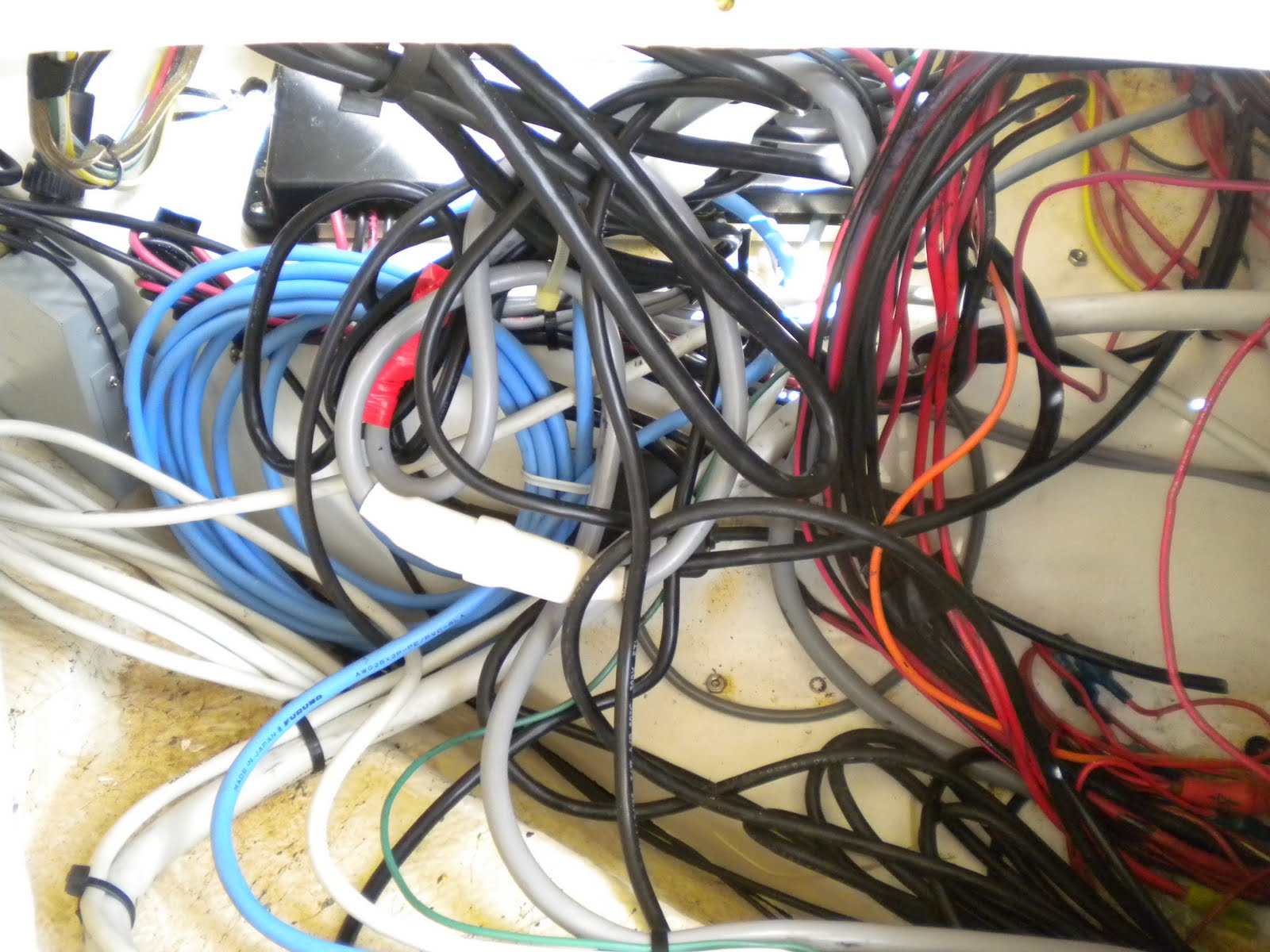
A zillion wires
It's not quite a zillion wires, but by the time we're through well over 300 connections will be made. An old Searay dash panel is coming out, and it's being replaced with a shiny new one. The ravages of time, and sunlight had faded the old panel. The plastic had embrittled and cracked in several places. All in all it had acquire an unsavory appearance.
Thursday, May 24, 2012
TV surgery
Old glass tube TV's never die, they just get thrown away. The is a very well loved Searay 48' sedan bridge, and the bad news is that it has an old electron beam gun TV inside of it. The good news is there isn't a VCR built into it. It works okay, but the coax splitter behind all of the gear has crapped out resulting in poor pictures on the other sets in the boat, and the sound quality is less than stereophonic.
The real trick in replacing older entertainment stuff is in not making the new electronics look out of place, and giving it, as much as possible a "factory made" appearance. The devil is all in the details.
Saturday, October 16, 2010
Big trouble in Transducer town
"That ain't going to grow back, it's broke, it's done, no glue or goo will fix it, did you really look closely at it?, and that is my professional opinion." This is my pronouncement as I look at the transducer while the boat is on the forks of the lift. The damage is the result of an untimely meeting of the transducer, and the wood bunk of a storage rack. Ah the miracle, and power of misapplied hydraulics. The boat, a middle aged 30'esque Searay had a Raymarine system, and I instantly knew what transducer was needed.
This unfortunate event occurred in a condo high and dry marina facility I often work in, and given the obvious mortification of the lift truck driver, I said I would do the replacement of the transducer at no charge, if the marina purchased, and paid for the materials. Karma is a wonderful, and cosmic thing.
So a few days go by, and the new transducer shows up. A local mechanic friend is there, and he comes over to give me a hand. I open the engine hatch, and stare down into a compartment which is dominated by two huge engines. I squeeze myself into a space that was never meant for human occupation, and doing a sort of awkward half hunched kneeling thing, I reach down, and feel around for the nut of the bolt that holds the front end of the fairing block in place. Much to my chagrin, I can't find it, it's just not there, and I also feel a in-hull transducer mounted right next to the broken transducer.
I wriggle back out, dragging my wrist across a sharp edge of a tie wrap (Inset your favorite expletive here), and cut myself in the process. I take Plavix, (a price I pay for earlier lifestyle indiscretions), and any small cut instantly looks like a gunshot wound, and sends onlookers fleeing in horror. Out to the truck I go, and with some liquid bandage, and waiting the sixty seconds for it to dry, I'm back in business. I climb under the boat to stare again at the transducer, and realize I missed something when I first looked at it. Among all of the carnage, I didn't notice there wasn't a bolt installed in the front of the fairing block. Look at the picture above at the triangular area, and you can see it's missing, and worse, it was never there at all.
Who ever installed the transducer mis-measured where to drill the two inch hole, and the bolt would now be forward of the engine room bulkhead, in an inaccessible area under the fuel tank. The good news is they didn't drill the hole at all in that location. The bad news is the bolt's job is to stop the fairing block from twisting at high speeds, and causing it to leak. The installer's solution to the problem was to apply copious quantities of 3M 5200 everywhere to keep it in place.
The transducer still has to be removed, but the access to the big nut in the engine compartment is so limited, I can't break it loose, so out comes the angle grinder with a cut off wheel, and twenty minutes later it's history. A few minutes later all of the goo has been has been removed with an assortment of sharp implements.
Now it's time to talk to the owner about the problem. I don't want to install the new identical transducer, for obvious reasons, and my solution is to replace it with a low profile tilted element transducer. No bolts, much harder for the fork lift operators to break, it will cost less, and all will be better for everyone.
A marina staffer dials the number, hands me the phone, and everyone retreats. Hi, I'm Bill, nice to meet you, this is the problem, and I think this is what we should do, no it won't have a paddle wheel, but you won't miss it, no SOG does not come from the paddle wheel in a Raymarine system, in the Raymaine system you only see paddle wheel "Speed" in a data box, and you don't currently have one set up, I'm sorry, but I didn't install it, this is really a better solution, no the transducer is made by the same company, and I can get one on Monday, you're doing a burial at sea on Sunday?, and you're going on a trip Monday that has been planned for weeks?, can't cancel the reservations?, but you have depth from the other transducer, the problem is that you are running both transducers at the same time, and they interfere with each other, and on and on we go.
The owner is really a nice guy, on the phone at least, but I have not met him in person. In the end, I took an old Garmin transducer I use to test sounder modules, and installed it, to plug up the hole so the boat is usable. The owner will advise me when the boat is back from the long planned trip, and that boat had better be used on Sunday, and gone on Monday.
I write, I eat, I deal with marine electronics, and I'm hungry for more.
I install transducers in boats with "No Reservations".
The lines above are a small homage to Anthony Bourdain's "No Reservations" show on the Travel Channel. I love his writing style. The mix of both witty, and cynical ennui, with an almost childlike exuberance for all things pork, is most clever. His show is one of my favorites, and you can find his blog here.
Tuesday, August 17, 2010
Robotics, automation, and the single boat builder, a short look forward.
Sometime in the eighties, I was was a salesman for a robotics company (PaR), and was looking for new gantry robot markets. I called several of the larger boat building companies, and asked if I could come and look for possible applications of this technology. One of the companies I spoke to was Searay, and a nice young guy named Rob Parmentier, agreed to meet with me. Rob was a gracious host, a good listener, and spent several hours with me, but alas, the time was perhaps too early for this technology, and no order would be forth coming. Rob, I understand, has done well with Searay, and although I don't think he would remember the several hours he spent with me, I would hope that the conversation would have at least piqued his technological curiosity. Most of the other companies, just said they weren't interested, and didn't need any automation.
A PaR gantry robot cutting a hull mold plug.
In my youth I was as a rigger on the Excalibur line at the shiny new Chris Craft plant in Bradenton Fl. The process of building a boat then, went like this. A bunch of guys in the lamination shop would be making, cleaning, prepping molds, and spraying them with gelcoat. Then out came chop guns, laying sheets of fiberglass, and using lots of little metal paint rollers to squash it all flattish. A bunch of man hours later you had a hull. When the hull was cured, jigsaws, and grinders were used to gnaw the excess fiberglass away following a line drawn by someone with a Sharpie. The same process would happen to the the top/deck structure. The deck was placed on the the hull, usually with a lot of pejorative vocabulary, pry bars and a couple of big guys jumping up and down on top of it. Eventually the two pieces were finally screwed together.
The now sort of finished deck and hull was placed on a dolly with wheels, and it was pushed onto the finishing line. The engine crew would get it first, and when they were done, everyone would stop, and push every boat on the line up one space, to the next station.
I did final rigging. That consisted of taking parts made by the wood shop, often covered with a carpet like substance that we called monkey fur, and installing them in the boat. This included bulkheads that separated the cabin from the cockpit. Sometimes the parts fit okay, sometimes they didn't, but the carpet beading stapled on the edges, made them look like they fit, in most cases.
Each boat had several molds, and none of them were identical, close mostly, but again not identical, and the halves were not exact mirror images. The mold makers were talented, but like all hand made products, there were differences between each mold for the same vessel. The end result was a lot of parts had to be modified, tweaked, or custom made, and this was a time consuming task.
I did final rigging. That consisted of taking parts made by the wood shop, often covered with a carpet like substance that we called monkey fur, and installing them in the boat. This included bulkheads that separated the cabin from the cockpit. Sometimes the parts fit okay, sometimes they didn't, but the carpet beading stapled on the edges, made them look like they fit, in most cases.
Each boat had several molds, and none of them were identical, close mostly, but again not identical, and the halves were not exact mirror images. The mold makers were talented, but like all hand made products, there were differences between each mold for the same vessel. The end result was a lot of parts had to be modified, tweaked, or custom made, and this was a time consuming task.
A PaR gantry robot waterjet trimming a fiberglass part
So, where do we stand today, with boat building technology? Things are better in many ways. CAD designed boats are becoming more common. CNC cutting systems now cut out wood, and Starboard parts. Gelcoats, epoxies, and resins have made a quantum jump in quality, and more boat builders are willing to entertain new manufacturing technologies. Good procurement, inventory management, and scheduling software is now becoming common. But sadly many boat builders still build boats like they did in the seventies.
A PanelMate CNC cutting system
In the US, cars are built, even in a bad year, (2009) at the rate of about 10 million vehicles per year, by a handful of manufacturers. The fact that you can buy a new car, for $15,000, made of thousands of parts, that will work reliably for years, is a testament to engineering, automation, and most of all volume. You need a car, but you want a boat, and although the numbers are difficult to come by, there are over 300 US based power boat builders, all competing for a bite of, and again the numbers are hard to find, about 250,000 units or so this year. No matter where you turn in this market place, you have a huge number of competitors, all chasing the same clients.
A CAD hull design by 3D Boat Design
So at this point, I am going to put on my conical hat, with stars and crescent moons on it, cast my chicken bones, and attempt to prognosticate what builders will need to survive in the coming decades.
At the very top of the list is CAD designed boats, and robotically cut hull molds. CAD based technologies allows you to iterate, and optimize designs. Robotically cut molds, assure parts fit correctly, and allow for more complex shapes to be integrated into the designs. If you don't do anything else, do this. Everything will fit better inside the boat, if the hull is precisely made. If you can't afford the equipment to do this, use a subcontractor, they are out there.
There is no point in doing the above, if you can't properly trim the parts after they leave the mold. If you know exactly what the shape of the part is, it is easy to automate the trimming process.
Since you now have precise molds, you can now use robotic spraying robots to apply mold release compounds, gelcoat, chopped glass, and other similar coatings. The robots can spray the exact amounts, at the exact thicknesses. You will gain material savings, time savings, quality, less warranty expense, and reduce personnel exposure to sometimes very nasty chemicals.
Configuration Control is critical to after sales dealer, and technician support. This is the system that keeps track of what parts, and materials that went into a particular vessel, and management of all of the engineering drawings. There is nothing worse than calling a manufacture, to get a wiring diagram, and finding out it doesn't exist, or you're trying to match a fabric, and no one knows or remembers where it came from. Wait a minute, I will walk out on the line, and see if I can find one being built, and e-mail you a picture of where the thingamabob was installed.
There are many other items that can be on the list, but these are my big four. We can add to this list environmental remediation systems, green technologies, interior component fabrication technologies, and much more.
So my summary goes like this, the more forward looking companies will prosper when the financial outlook improves, because they will be more efficient, their products will sell for less, be better quality, and more supportable as their technologies continue to improve. The companies, that are not making this investment, will falter, and fall by the wayside.
After this little discussion, I want to point out that there are some boat builders out there aggressively adopting these technologies, and notably Brunswick, Yamaha, and Stingray. Go Google these companies, and I think you will be pleasantly surprised, and when you are shopping for a boat, ask about their manufacturing technologies, and especially if they have a configuration control system.
My last thought for boat builders is that when nice some salesperson calls, and wants to tell you about a new technology, take some time to listen. He or she may have just the thing you need to give you an edge.
Configuration Control is critical to after sales dealer, and technician support. This is the system that keeps track of what parts, and materials that went into a particular vessel, and management of all of the engineering drawings. There is nothing worse than calling a manufacture, to get a wiring diagram, and finding out it doesn't exist, or you're trying to match a fabric, and no one knows or remembers where it came from. Wait a minute, I will walk out on the line, and see if I can find one being built, and e-mail you a picture of where the thingamabob was installed.
There are many other items that can be on the list, but these are my big four. We can add to this list environmental remediation systems, green technologies, interior component fabrication technologies, and much more.
So my summary goes like this, the more forward looking companies will prosper when the financial outlook improves, because they will be more efficient, their products will sell for less, be better quality, and more supportable as their technologies continue to improve. The companies, that are not making this investment, will falter, and fall by the wayside.
After this little discussion, I want to point out that there are some boat builders out there aggressively adopting these technologies, and notably Brunswick, Yamaha, and Stingray. Go Google these companies, and I think you will be pleasantly surprised, and when you are shopping for a boat, ask about their manufacturing technologies, and especially if they have a configuration control system.
My last thought for boat builders is that when nice some salesperson calls, and wants to tell you about a new technology, take some time to listen. He or she may have just the thing you need to give you an edge.
The Dodge Boat works circa early 1930's. They closed in 1936. Funny how it reminds me of a boat manufacturing line I saw a few months ago.
Saturday, August 7, 2010
Searay redeaux, and the "Laws of unintended circumstances".
This is a make over story, that also illustrates the "Laws of unintended circumstances." The vessel below is an older, but well loved, and cared for Searay. The chartplotter you see below (upper left) is a old Northstar unit that finally bit the dust. The Furuno below it is an older, but fully operational GPS chartplotter, and radar. After discussing what to do with the owner, he decided to install a new Garmin 5212 touch screen unit to replace the now deceased Northstar, and since the older Furuno radar was still working well, he would keep it in place.
Searay, and many other builders, used burled wood looking plastic panels in their consoles. The exact match to the existing panels is no longer available, but the owner found a 2' X 4' piece that was a close match, and it was decided to use the new plastiic for the location where the new Garmin was going to go, and to replace the lower Furuno's panel with the same material. So out come the units, leaving two gaping maws in the console.
So far, everything has gone according to plan, the units came out, along with the old panels. The panels were delivered to Delcraft for fabrication, and unbeknownst to me, the "Laws of unforeseen circumstances" were just getting ready to go into effect. Behind the Furuno is what I call a "Spaghetti Bowl". These occur through the years as layers of new wiring, get laid over the old wiring. This was also exacerbated by the owner cutting a lot of wire ties, in an troubleshooting effort to identify the now defunct Northstar wiring.
It's not that I have a social conscience, I was a salesman for thirty years, but when I saw the spaghetti bowl behind the Furuno, I couldn't just leave it that way, and I asked my young helper to pull the old Northstar wiring out, and clean up the mess. The boat was stinking hot, and along the way, I was told he found a red wire that wasn't attached to anything, and what should he do with it? I'm not surprised that you find extra wiring, especially in an older boat, and I just said "tie it up".
After the wires were tied up, the new Garmin 5212 was tested, the software was upgraded to the current level, and I was pleased with the appearance of both the new Garmin, and the two new panels. The work looked factory original, and I don't think a visitor could see the slight difference in the color of the new panels.
Anyone who repairs anything, whether it is a boat, car, or plumbing, is familiar with the phrase, "Everything worked perfectly on my whatever, until you fixed the whatever". "The "Laws of unintended circumstances" come in three less than tasty flavors.
The first flavor is "Bile." This wretched flavor comes from someone who knew it wasn't your fault the whatever is broken, and is just trying to see if you will fix the problem for free. Fortunately, I have only had this happen a couple of times, and these people are no longer clients.
The second flavor is vinegar. This flavor occurs when the client, thinks you broke it, but you really didn't. You changed the bow light fixture, and now the radio in the console is broken. These apparently unrelated events can link together, in an owners mind, in many weird, and wondrous ways. Lets see now, they both use electricity, I have a beard, Abraham Lincoln has a beard, so I must be Abraham Lincoln. You go to the console and pull out the rusted hulk of a ten year old car radio, and say really?, seriously?, really now, and hand it to the owner. The knobs won't turn, the antenna wire has corroded into oblivion, and you watch as water drips out of the chassis. Truth be told, this does not often happen, and the owner is not trying to intentionally screw you. He or she truly believes this is a fact, and with some minor efforts, the issues almost always resolve themselves.
The last flavor taste likes alum. You get this mouth puckering flavor, when the "Everything worked on my whatever, until you fixed the whatever", and it is your fault the "whatever" no longer works. In the case of the Searay we are discussing today, I blithely mentioned to my colleague to tie up that red wire mentioned above, and didn't think anymore about it. It turns out there were actually two red wires, and they fed power to the relays, that turn on the Caterpillar diesel's control panels. The engines ran fine, but had no instrument displays to tell you what they are doing. Sometime in the past something changed in the console. The two red wires were connected the the ignition switches, and were tie wrapped on top of the original harness. The wires then kind of dangled their way unsecured over to the relays. All of the other relay wires were bundled together, except these two. In pulling in the new cables for the Garmin, and removing the old cables from the Northstar, the two unsecured red wires got pulled off, and were tied up with all of the other wiring.
I should have looked more closely, when I was told there was one unidentified wire, but I didn't, and the following morning I was back on the boat puzzling out what had happened. It didn't take long to fix, and the owners very graciously accepted my apologies for the faux pas, and were happy with the work.
In an odd sort of way, I have learned to like the alum flavor, unlike the bile, and vinegar flavors, you are going to learn something when your mouth puckers up from the alum taste.
Wednesday, March 10, 2010
Bob and Carol, and Ted and Alice buy a boat. A short Goofus and Gallant story, with apologies to Highlights magazine
Sometimes I just start a story, without knowing exactly where it is going to take me. More often than not, they end up in my Museum of Shattered Dream's vast collection. We will just have to see what path this one wends down. The vessel above proves that there is the right boat for everyone, out there some place.
Bob sells his company in Tucson, and with his wife Carol, they buy a canal home in Florida. The big truck comes with their stuff, and they get settled in. Sitting out by the pool, with an adult beverage, Bob looks down the canal at all of the neighbors boats. The house across the canal has a Boston Whaler Outrage, the young couple to their left have a long sleek fast colorful powerboat, and the couple to the right have a 52' Searay sedan bridge. Bob stares at his empty dock and thinks, all the neighbors have boats, we should have a boat also, or we won't fit in. So he turns to Carol, and says "we should buy a boat." Carols, says, "but dear, you don't know anything about boats.", to which Bob states, "whats to know, its like driving a car."
On the next canal over, Ted and Alice have just moved in, and are also enjoying an adult beverage out back, and Ted looks down the canal at all of the boats and thinks to himself, a boat might be fun. He mentions this to Alice, who says, "But Ted, you don't know anything about boats." Ted says, "you're right, but why don't we look into it."
The next week Bob and Carol, having decided they are going to buy a boat, start to discuss what kind of boat they want. Bob wants it to be fast and sleek, with lots of colors, and a refrigerator for the adult beverage mixers, and ice. Carol wants one that is big and comfortable, with a bathroom, square bed, leather furniture, and air-conditioning. So with all the important boating criteria having been decided on, off to the boat show they go.
Ted and Alice spend some time talking with friends about boating, and decide to join a local boat rental club. They try many different types of craft to see if they really like boating enough to make an investment, and they also take together several Power Squadron boating courses.
Bob and Carol go to the boat show, and after an hour of extensive research at the boat show, and much to the dealer's delight, they purchase the new 2010 Magnifico 50' cruiser. It has everything they want. A bar, lots of leather furniture, two huge 1000 hp diesel engines, a 40" plasma TV, and just imagine, they can even watch TV on the chartplotter thing while driving. Won't the neighbors be envious.
Ted and Alice are enjoying boating, but are still a little unsure about what they want. They have two small children, and need some room, but they don't want to start with something large right off the bat. They opt to buy a 26' foot cruiser. It has all of the basics to weekend on. They have a decent chartplotter installed, double check that they have good safety gear, and off they go.
Bob and Carol take delivery of the boat, and the dealer has a captain give them an orientation. There is a big package of manuals for the boat, that Bob stows under the settee, because Carol doesn't want that stuff laying around, and off go Bob and Carol. Bob is a little fuzzy on the concepts involved with the red and green signs that are stuck out in water, and he can't quite figure out that map thingy on the console. Even worse he can't find out how to turn on that nice lady's voice that tells him when, and where to turn. In less than twenty minutes, he is on a sandbar, with props that now look like tulips. Much to his chagrin, the vessel is hauled back to the dealer, and new props are installed complements of his Visa card.
Ted and Alice love boating, and use the little 26 footer at every opportunity. It leaves the dock stuffed with water toys, kids, fishing poles, and provides much pleasure. What was once awkward boat handling, is now graceful and competent.
The post mortem:Bob and Carol still have the boat, and it is now for sale. Bob hires a captain to take them out occasionally on nice days, (Carol gets sea sick easily) and it takes more effort to maintain, than he wants to put into it. They do use the barbecue on board, and the grandchildren love to sleep on it when they are in town.
Ted and Alice used the 26 footer for a year, and traded it in on a 34 footer. The new boat has more room for the kids, their stuff, and the adults. It is used often. They are now thinking of getting something larger, and maybe with sails.
Some of Bill's rules for boaters:
1. The bigger the boat, the less it leaves the dock. If it gets big enough, it will never leave the dock.
2. The more people watching you dock from the marina bar, the worse you will do.
3. Only amateurs have new looking boat shoes.
4. Always have paper charts on board. A blown fifty cent fuse renders all your expensive electronics useless.
5. A place mat from a seafood restaurant is not a chart, ever, and even if it looks like a chart, it's not!
6. At thirty knots, if the depth finder tells you it's to shallow, it's to late
7. If anyone tells you they don't need a chartplotter, because they know these waters like the back of their hand, hang on to something solid.
Ciao, Bill
Subscribe to:
Posts (Atom)