Friday, November 26, 2010

The S.M.I.T.E. Awards

A hush falls over the crowd in the large hall, as the president of S.M.I.T.E. (Society of Marine Installer Technological Entrepreneurs) walks up to the microphone holding three large envelopes. "Thank you for your patience, I know it's been a long night, but at last we are ready for the final awards." "As you all know, the prestigious, and coveted "Ron Popeil" awards are given to the applicants who have installed a chart plotter in a way that makes it theft proof. The judge's criteria is that it should be virtually impossible to remove, and survive in a console overnight, in the Mogadishu, Somalia "Thieves Market."

"Our esteemed judges have done their due diligence, and reviewed over a hundred contestant entries. So without further adieu, we will start with our second runner up. So let's give a big installers hand to Steve Stickus. The judges were very impressed with the massive amounts of 3M 5200 applied everywhere, and his technique of using a hair dryer to fully cure it, especially in areas where it was almost three inches thick. Steve wins a $200 Harbor Freight gift certificate, and the "Spray Hair" in a can trophy."

"Our first runner up is John Spawl, and the judges have noted that his finesse, and attention to detail, is alway a joy to see. John's talent is in making the install look perfect in appearance, while retaining all of the subtle security measures he is famous for, such as screws driven into slightly undersized holes, insuring the heads will snap off when removing them. The rounding of Phillips head screws with undersized bits, and his personal specialty of driving cross threaded nuts all the way down on the bolts. John wins a $500 Ace Hardware gift certificate, and the "Pocket Fisherman" trophy."

"Okay, I see the bar is getting ready to open, so let's get to the grand prize, and this year's first place winner, is Ian Sidious. Let's all give him that big installers congratulations, and a standing O."

"The judges were amazed at Ian's ingenuity. Starting first with placing the chart plotter as close as possible to the console's edge, and doing the actual install prior to having the console mounted in the boat. This insured that the two outboard fasteners could not be reached, or seen at all, and further making sure lots of extra bonding putty was used, to reduce easy access."


"Ian also used excessively long bolts, and managed to damage the threads just enough, to guarantee that two people would be needed to remove the nuts." 


"This clever approach created a triple threat, causing the potential thief to drill out the bolt heads, in a time consuming, irritating, and messy process."


"But to the judges delight, Ian had two additional treats in store to make thievery all but impossible. The first was the use of epoxy glue to seal the edges, and the "coup the gras" was a hole cut out that was just slightly smaller than the chart plotter, requiring a rubber hammer to beat it into place."  


"Congratulations Ian, you will take home the 1st place Ron Popeil "Veg-o-Matic" trophy, a $1000 gift certificate from Tractor Supply, and a collection of colorful designer Tyvek suits, which will give you that professional appearance you're looking for. So what do you have in mind for next year Ian?"

"Well I am proud to be a member of S.M.I.T.E, and of the contribution we all make to the world of marine electronics, and the theft protection we provide to our owners. I am experimenting with grade 8 bolts. They're really tough to cross thread, but with my new Tractor Supply gift certificate, I think I can now buy some hydraulic equipment to do the job. Thank you my colleagues, for this magnificent honor." 

Monday, November 22, 2010

Sea Ray entertainment console conceptual reiteration, and integration.

There are two kinds of boat projects. In the first group, the answer is obvious, and the path is clear. Mount the GPS on the hardtop, pull the wire to the console, and connect it. In the second group, the answer is less obvious, and there are many potential paths to completion. If problems are going to occur, it's in group two, especially if completion is time is being pushed. This is particularly true when your'e doing interior remodeling in a boat. 

This is Randy, and Vicki's Sea Ray 500 Sundancer, and we have seen a project on this boat before. It is an older, but immaculately kept vessel. The problem was the entertainment systems had become very dated. In the cabinet below, in the right compartment was a glass tube Panasonic TV, in the center section there was a flush mounted DVD player, a Clarion stereo, and below was storage for DVDs. In the left section, two 6 disc CD changers are mounted on shelves.


The goal is to remodel the cabinet to allow a new, and much larger flat panel TV to be installed, while keeping the appearance "Factory" built. So this is where the story title comes in. When you first embark on this type of project, it is difficult to instantly have all of the answers at your finger tips. The three of us sit in the cabin, stare at the cabinet, and talk about the art of the possible. Maybe we could pull out the old TV, make a panel that would cover the hole, and mount a new flat panel TV on it, or we could cover the hole, and mount a new TV elsewhere, and so on. This was the most valuable aspect of the project, and out of the iteration, a conceptual approach forms.  


The plan we agreed on, was to make a new panel that will cover the entire face of the cabinet. A very accurate template was made, and a new panel was fabricated by Delcraft Acrylics. In order to get this to work well, the panel had to fit perfectly, and as you can see below, it did.


So again, we all sit in the cabin, and talk about what we are going to do. It was decided that we would do a cut out in the panel where the CD changers were located. My first thought was to get a router, and cut out a matching hole, but after some cogitating, I decided it wouldn't end up with the type of finish we wanted, and one small slip of the router, would required a new panel to be fabricated. After thinking about it, I taped some paper over the hole, cut a big X in it, and using a small jewelers screwdriver, I burnished the edges, and the result was a perfect pattern of the hole.


The paper is neatly covered with copious amounts of double faced tape, the panel is pushed back into place, and with some modest banging with my fist, the paper adhered to the panel, and the position of the cutout is exactly where it is supposed to be. Meanwhile, Randy, and Vicki go TV shopping, and armed with the maximum dimensions, they come back with a beautiful 36" Samsung LED TV that is only about an inch thick. 


Now for the easy part. Drop the TV onto the panel, center it, and use a Sharpie the trace the edges. The TV frame is square, and about 1 1/2" wide, a new cut out line is made that is 1/2" smaller all around. The panel cut out templates are now done, and off it goes to Delcraft, to have the final cutouts made.


The panel comes back, and a trip is made to Home Depot for some sturdy brackets, and a piece of 2" x 12" wood to attach the mount to. I picked out a mount that would allow the TV to slide from side to side, meaning I only had to get the vertical position correct, and I could easily adjust the side to side reveal. 


So now it is time to stick the panel in place. The TV is adjusted a little to the right, and some cleat blocks are placed, on the mount to keep it in place, and the panel is pushed into place.


The end result is stunning in appearance. The TV appears to be actually molded into the panel, and the touch controls are just above the frame allowing, by design, access. 


The original smoked glass door is reinstalled in the CD changer compartment, and the end result looks better than the original configuration.


When the TV is turned off, the the whole panel looks like a black mirror, and the very hardest part of the whole project, was in trying to get good pictures. The panel is very much like a mirror, and every picture I took with the flash was awful, and even using ambient light, there were still a lot of reflections. My professional lighting crew must have been on vacation on this day, or I'm not paying them enough to hang around.


It's still not quite complete. The Clarion stereo is going to be mounted this week into the panel above the CD changer compartment, and the wire harness is ready to go for it. There was no room for the new Blue Ray player, so it will live on the counter, or in its box. The HDMI cable for the Blue Ray player is attached to one of the clips that once held old rope lighting, so it is out of sight under the cabinet when not in use. A very clever wireless surround sound system was installed above the cabinet, hidden under the port hole, and the sub-woofer is stashed under the sofa. New cabling was pulled in from the satellite receiver, to the TV to support an upgrade to HDTV in the future. The panel will get final attachment with countersunk #4 SS flathead screws, with black painted heads, rendering them hard to see.

The real point of this story, is that the end results were terrific, because Randy, and Vicki took their time, were patient, and the ideas were discussed, and iterated many times. Their avid participation, made my job easier, and the end results much better.

The second point to the story, is letting people who are good at what they do, do it. I could have never done the panel fabrication, as well as Delcraft did it. It would have been okay, and by that, I mean it wouldn't have looked like it was chewed out by beavers, but it would not look, or fit as well, as having it done by someone who does this for a living, and has all of the right tools. This is better summed up by a The Hull Truth poster's aphorism, "Find out what you don't do well in life, and then don't do it".

My thanks to SpongeBob, and Patrick for their modeling in the TV pictures, it was as nautical as I could find, at the time. Where are the movies "Mutiny on the Bounty", or "Perfect Storm", when you need them?  

Thursday, November 11, 2010

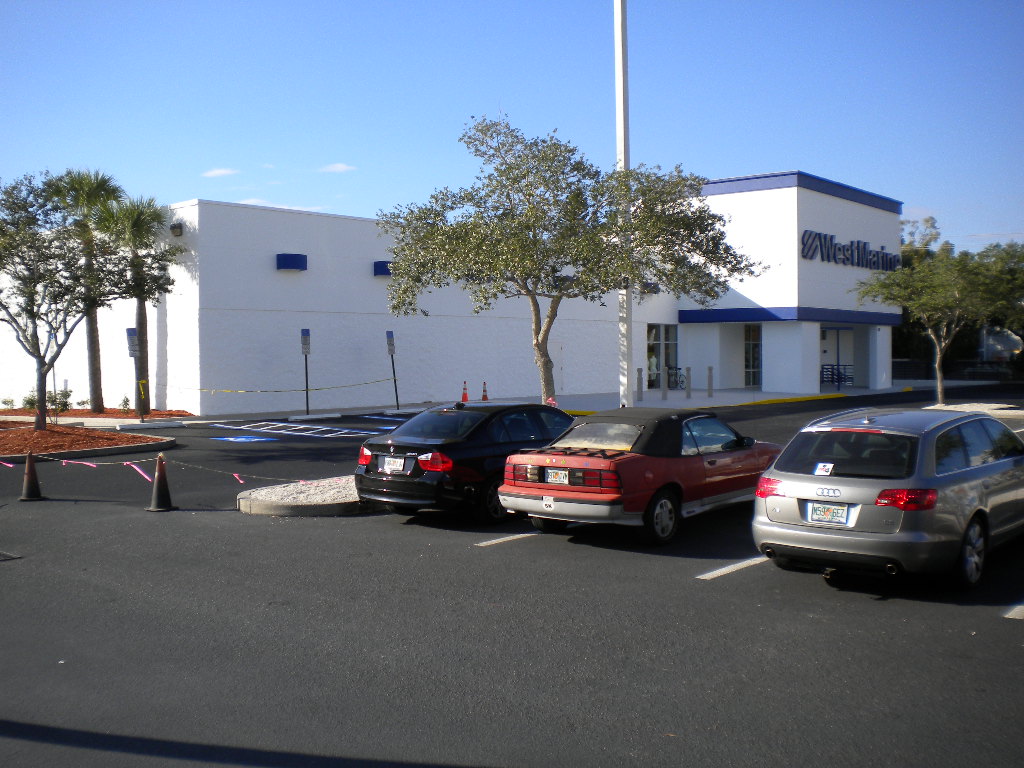
Sarasota gets a new West Marine "Flag Ship" store.

It has taken some time to build, but I have been watching the new West Marine store rising like a Phoenix, from the ashes of a failed retail giant. The building had been hulking empty for about a year, when workers started its make over.


We begin with a cavernous empty shell, and it doesn't take long, before the transformation starts to take shape. Floors are repaired, ceilings drop in places, are painted, and lighting is installed.


Fixture crews appear, along with large trucks, and a store starts to take shape. Every fixture is accompanied by paper work, that describes its layout, for the stock yet to come.


A huge electronics section in the middle of the store is assembled, along with a curved hardtop, that is featuring "top of vessel" electronics, and the Garmin radar array will draw your attention, because it will actually be spinning. 


And the merchandise starts to arrive, and I mean a lot of merchandise arrives. A small army of West Marine staffers spend several weeks stocking the shelves, and putting the final touches on the store. New employees are being trained, and new systems are being put into place. Work is wrapped up on the exterior, and the parking lot gets resurfaced, and re-striped.


The big opening day arrives, and the store gorgeous. More than three times larger than the old stores. The sales floor is 21,000 square feet, and heavily stocked. I'm not sure of the exact amount of items, but I would guess that there are about 15,000 in the store. The breadth of merchandise is impressive, especially in the basic items I buy every day.

The store is also the new west coast of Florida's Port Supply depot. This means, if I need something that isn't in the store (a lot less likely now), it will be available in the store when it opens the next day. On opening day, I was wandering around with a colleague, and he needed two shims for a specific Harken cam cleat, and there they were on the shelf. Odds were, in the old store, they would be in the warehouse, and would have to be shipped in. Not the case with this store.


There is now a very large fishing department, and all of the watercraft, inflatables, and motors are on display.


A full service engine department, to help you keep your motors running, is in the back of the store, and there is a huge apparel department in the front of the store, with new brands, emphasizing West Marine's commitment to women boaters, and my favorite, real changing rooms. 


The end result is terrific, two smaller stores in the area were shuttered, and replaced with an impressive destination store, with a massive inventory, and most importantly, at least to me, is a staggering array of operational marine electronics on display.


Above is my friend Wayne Seel, the general manager of the new Sarasota Flagship store in a moment of exuberance, and he deserves it. Many West Marine employees worked very long hours, for many weeks to make this happen, and it was all worth it. Wayne said, "My vision of what West Marine should be in Sarasota has been fulfilled." Good job Wayne, and West Marine.


Sunday, November 7, 2010

Death hides in the bilge

Walking down the long dock to my clients boat, I kept getting whiffs of sewer gas, and I thought to myself, someone's boat needs to see the doctor. I step aboard the clients boat, open the sliding glass door to the main salon, and the stench bowled me over. My first thought was the holding tank had to have exploded, or at least sprung a bad leak. I turned on the air conditioning systems, and suspecting that maybe water had evaporated out of an S-trap, or loop, I flushed the heads, and let some water stand in them, ran sink taps, and showers, and then the odor then seemed to dissipate. I opened the hatch to the engine compartment, climbed in and, checked the holding tank, and the lower portions of the bilge, but the whole area appeared to have less odor than the the main salon initially did. At this point, I had already made several errors, but  I never realized it. I called the owner, and told him about the problem, and the owner contacted the maintenance company. A tech came out, and he had seen this problem before, and recognized the odor as hydrogen sulphide gas. 


This boat is very well maintained. I take care of the electronics, and another firm does everything else. The boat had been checked a week earlier, and the batteries had been checked for water levels. This is a 24 volt boat, with two banks of four batteries each, and you can see one of the batteries above, with a now swollen case. There is a high quality charger on board, and only the starter battery bank, has a temperature sensor. Somehow, in a very short period of time, four identical batteries in the house battery bank, nearly boiled dry, and the side effects of this, are what this story is all about.

The lead acid batteries used in our boats, are a far cry from the one invented by Gaston Plante in 1859. Like most of us, I know there are lead plates, submerged in an electrolyte (sulphuric acid and water), that undergo some electrochemical reaction to create Mr. Electricity, and that is about where my real understanding stopped, until recently. Batteries have come a long way from Mr. Plante's simple roll of lead separated by linen cloth, and immersed in sulphuric acid. Todays batteries are sophisticated structures, and are made of a complex mixture of metals, and chemicals.


The primary ingredients we are going to learn about, are hydrogen, sulfur, oxygen, and antimony. Your battery, in its normal course of activities, creates both hydrogen, and oxygen while charging, and these are reabsorbed during the discharge cycle. It's when things become abnormal in your battery, that bad things can happen. If the electrolyte (water and sulphuric acid) levels drop in the battery, exposing the plates, sulfates that are now exposed on the lead plates, start to combine with the hydrogen gas created during charging, and hydrogen sulphide gas is created.

Two other gases can form, depending on the construction of the batteries. Lead by itself, is not a very strong material, and is generally alloyed with the element antimony to make the lead stronger. Another item, that can be present, in the lead plate's alloy mixture, is arsenic. So again, if the plates become exposed, the hydrogen gas atoms will also combine with antimony atoms, to make Stibine gas. And if arsenic is present in the alloy mix, Arsine gas can be created. Both of these are even more toxic than hydrogen sulphide gas, and also very flammable.

Hydrogen sulphide gas, sometimes called sewer gas, or rotten egg gas, does occur naturally, and is created by decomposing organic material. It does smell very much like the inside of your holding tank. So while I was running around inside the boat, thinking something was awry with the holding tank system, what I was really smelling, was hydrogen sulphide gas, and this is a dangerous, and toxic material. It is very flammable, heavier than air, and very poisonous. At low concentrations, you can smell it, but at slightly higher concentrations, around 100 ppm, it paralyzes the olfactory nerve, and the odor goes away. So when I went down into the engine compartment, and It didn't seem to have any notable, odor, my smeller had been shut down by the gas. At between 300 to 500 ppm, death is a possibility, and at 1000 ppm death is almost immediate.

I did a lot of digging around, and cases of pleasure boaters who have died from breathing hydrogen sulphide are rare. Less rare are explosions on boats initiated by hydrogen gas/hydrogen sulphide gas coming from batteries. In the end, your boat batteries are both a blessing, and if not properly cared for, a curse.

In this case, I am not sure what happened, other than somehow the four large flooded lead acid batteries, in one of two battery banks, in a very short period of time, had the majority of the electrolyte boiled out of them. This created a very dangerous situation, either from explosion, or breathing the associated gases. New batteries were installed, and everything now appears normal. But the reason the problem occurred in the first case, needs to be found. Charger problem? Installation problem? Alternator problem? Shorted battery?

The typical gas sensors on a boat are not designed to sense these gases, so no warning was available, other than the very strong odor, which goes away with exposure. I have to be honest, I was a more than a little startled about both my specific lack of knowledge, and my potential exposure to the gas.

I will do my best to discover the cause of the problem. It had to have had a source, and I will do a second story soon, when I find out what actually did happen, and learn even more. I will also include some do's, and don'ts when dealing with your batteries, and some thoughts about battery types to use.  I am a lot smarter now, and I hope to get even smarter.

If you have had any personal experiences with hydrogen sulphide gas, and or battery related explosions, I would like to hear about it. You can use the comment, or the email links below. Thank you, Bill

I have a few links below to review.

ybw.com/forums/
Case report of a marine technician killed by an exploding battery
Hydrogen Sulphide in low maintenance batteries

The diagram of the battery is from the The Association of European Automotive and Industrial Battery Manufacturers website

Monday, November 1, 2010

Fisherman's Paradise, an amazing five star floating resort.


On a gorgeous Wednesday morning, I jump onto a work boat loaded with boxes, contractors, and tools. The boat heads out of the pass, into a dead calm Gulf of Mexico. No navigation gear was being used, and I asked my host how we were going to find the ship. He chuckled, and said, "all you have to do is go west, and you can't miss it". He was right. In about 30 minutes, you could see a small bump on the horizon, which slowly grew into the most amazing vessel I have ever seen. We swing around to the back, and pull into the marina, that is actually built into the aft end of this 400 foot craft.


What you are going to see, is the first look, at a most unique, floating 5 star resort hotel, dedicated exclusively to providing guests with world class fishing, and diving experiences. There is no amenity, or detail that has been overlooked. Construction has been ongoing for five years  now, and it's currently about 85% complete. 


My host takes me to the main lobby check in desk, where I sign in. He introduces me to the staff, and gives me a quick tour, (it took an hour), and then said have at it, and the rest of my day was spent wandering agog through this immense, and exciting vessel with my camera.


I wander down a beautiful hallway on the first level, and check out some of the rooms.


All of the accommodations are lovely, and consist of spacious twin queen rooms with full en-suite baths, VIP single king rooms, that also feature jacuzzi tubs, and beautiful multi-room suites. All rooms have at least two large windows that face the ocean, have large flat screen TV's, beautiful woodwork, and elegant finishing touches. 


On the second level is a full service bar, with a granite bar top, and seating facing the sea, although on this craft, it is hard to find a location where you can't see the water. Bright ambient lighting abounds everywhere. 


The bar resides at one end of a very large, and comfortable lounge, which will provide the perfect place to tell your fish stories, after a perfect day out catching the big ones.  

The lounge also includes a custom built 900 bottle wine, and cigar cellar, has quiet nooks for reading, or chatting, and features a massive salt water aquarium, that separates the restaurant from the lounge.


Off the lounge, and facing the sea is a lovely restaurant that is staffed by professional chefs who are prepared to cook your catch, or serve you from a full and varied menu.


The galley is a state of the art. custom built facility, that would be the envy of most landlocked restaurants, and has the capability to prepare excellent food for larger day events.


On the bow a 70' swimming pool is being completed, that curves around a swim up bar. The pool bar is also accessible from the two sun decks on either side.

As I mentioned, the amenities list goes on and on. There are two separate gyms, one dedicated to weight machines, and, the other to aerobics, a sauna, and even a movie theater.


Fishing and diving is the mission, and the very clever gantry structure is part of this. The primary fishing fleet consists of two 32' center console Boston Whaler Outrages, two 28' center console Scouts, a 60' Viking Sportfish, and the 50' head boat that will be used for larger fishing parties, Fisherman's Paradise also has additional boats available for larger functions.

On the aft starboard deck, a set of rails hold the cradles for the four center console boats. This clever gantry system picks up the boats from the marina, after a day out on the water, and places them on cradles, that are then shifted forward, so the next boat can be picked up. Overnight, the boats will be cleaned, serviced, and in the early morning they are restocked with ice, bait, beverages, and gear.

The fishing, and diving details are endless, and include a very large capacity saltwater ice-maker for fish boxes, a walk in flash freezer for customers catches, at least what isn't going to be eaten for dinner that night. A full Tusa dive shop, with Tusa certified staff, and air, and nitrox tank refilling systems. Guests will use all top of the line Shimano equipment, and private storage lockers are available for member's fishing personal gear. A large stainless steel fish cleaning station is also located on the aft deck.


I didn't want to forget the two King Kong sized tanks for the live bait, with fresh sea water circulation, and the freezers for the frozen bait to boot. I have strained my brain, and I can't think of anything else that you could possibly need to catch the big one, or two, or three.


But of all of the craft attached to this floating fishing eden, the one below is my favorite. It is a stunning Sikorsky S-76 executive helicopter, that lives on the heliport on the top deck.


This beautiful seven passenger aircraft is used to transport guests from the mainland, out to Fisherman's Paradise, and back. For those who would prefer a more pastoral transportation experience, boats are available for transport also.


The builder's of this vessel, are all avid sportsmen, and very environmentally conscious. One of the most notable aspects of Fisherman's Paradise, is the huge investment in environmental systems. All garbage that can be incinerated, is, in a special low emission system. All other garbage is compacted, and shipped to shore for recycling, or to a land fill. Waste treatment systems process all grey, and black water, and only filtered, and sterile water is returned to sea. Even the remnants from the fish cleaning station is processed on board, and not just thrown into the water.

To that end, Fishermans Paradise is in current discussions with several universities to set up a marine research station on board, and they are actively exploring the possibility of acquiring a submarine to support this type of research. There are also discussions with local counties, about managing, and expanding artificial reef programs for the area, and they are developing a program to allow local charter captains to participate in the project.

The ship is a virtual ecosystem by itself. There was never a time I looked down into the water, and didn't see large quantities of bait fish continually circling around this amazing vessel. With a 3/4 of an acre footprint, sea life abounds under the vessel, and underneath you can find barracuda, cobia, and many other species, including occasional visits from whale sharks. Last year several hundred migrating humming birds stopped on the boat for a day to rest up, before moving on.


So what will happen next? Fisherman's Paradise is quickly nearing completion, and the ship will go into dry dock in December, to have a bottom job, and to have the vessel's hull cleaned, and repainted, so it will look as good as the rest of the ship does now. A series of private soft openings will occur after the first of the year to test, and wring out the resorts capabilities. Sometime in the early spring, Fisherman's Paradise will fully open. A large floating dock system is being fabricated to allow additional boat dockage for guests, and to support upcoming planned fishing tournaments.

When complete, Fishermans Paradise will be relocated near the famed west coast of Florida's middle grounds, in waters still close enough to support quick access to excellent diving sites, and world class fishing locations. Fisherman's Paradise will periodically be moved to new sites such as off Ft. Jefferson, in the Florida Keys, Cancun Mexico, the Lump off of Venice Louisiana,  Panama, and back again to the west coast of Florida.

I will visit Fisherman's Paradise again for you, after the dry dock make over, and it is completed, to give you another look. There is still lots of room for expansion, and there are many new exciting features planned for the future.

So what's a truly perfect day? The helicopter picks up my wife and I, and in a hop and skip, we are well off shore, and settling gracefully onto the heliport deck. We check into a lovely twin queen room, and take a quick swim. Later we wander down to the restaurant, have a superb dinner, while watching the sunset, and visit the lounge afterward, for a couple of drinks, and conversation. The sun comes up the following morning, and I head out into the Gulf, for a day of fishing. My wife prefers lazing about with a good book, on one of the pool decks, with a drink that has an umbrella in it.

I catch a 20 lb Black Fin Tuna, a large Grouper, and hook something huge, but alas it gets away (it will make for a great story anyway). At the end of the day, the chef cooks my catch for dinner, and with plenty of wasabi it enjoyably disappears. We spend the evening in the lounge, telling fish stories, and off to bed we go. In the morning, we pick up a cooler that is packed with fresh tuna, and grouper, and the helicopter whisks us back to the mainland. World class fishing, with a beautiful room, at a stunning facility, and no spending the night sleeping in a bean bag chair. Welcome to Fisherman's Paradise.

To learn more about Fisherman's Paradise, click here. It is amazing, and surprisingly affordable!

Fishermans Paradise revisited after a makeover story is here.

If you came here on a direct link to this article, you can find my other articles in the archives to your right, or you can see the current articles here on my home page, thanks, Bill Bishop 

Thursday, October 28, 2010

Roadster in the house


I just don't get what the typical go fast boats are all about. Before the owners of these boats start to whip me with their gold chains, I get the "Need for Speed", I just don't get these boats.

I would love to have the "where with all" to own a fast car, and when I say fast, I mean fast as in a Bugatti Veyron, or a Aston Martin DB9. Now imagine what the DB9 would look like if you asked Aston Martin to design one, that would go just as fast, and have room to sleep in it at night, (maybe this would be a good topic for Top Gear), and the typical go fast boat is what you end up with.

So here is my impression when I get on a generic go fast boat. You enter, often precariously, into a cockpit that is generously covered with copious quantities of colorful hides, from the rare Nauga. Stepping down into a cabin designed for Hobbits, onto a purple plush carpet, and with bent knees, and a cricked over neck, you survey the less than expansive space. A galley is to port, with a fridge that will just hold a couple of bottles of wine, and maybe a six pack of beer, and a sink that is just large enough to ice down a bottle of wine. To starboard, is a tiny claustrophobic compartment that has a head, and another pretend sink. Lifting your eyes forward, is a very low white pleather couch, facing a formica cabinet, with lots of mirrors above it, and plenty of gold plastic trim. The "Piece de Resistance", all the way forward is the love nest. A triangular bed, with a leopard print bedspread, that you can barely crawl onto on your hands and knees. With poor access to the bow, often no anchor locker, loud, poor ventilation, and hard riding, they are a classic case of function follows form, with marginal accommodations, and garish interiors. Ouch, quit hitting me with that gold chain, your'e going to break it.

I feel better now that this is off my chest, but all of a sudden, a new go fast boat moves into my town, and all of my perceptions are suddenly changed. The boat below is the new Nortech 80 Roadster. This is a deceptive vessel. At a first glance, it appears to be just 40 feetesque long, but when you get up next to it, it's substantial in scale. With a length of just shy of 80', and a beam of 16', I feel small next to it.


A huge cockpit, and a very commodious European style interior, with a  three cabin layout, that sleeps 6 in comfort. There is a full galley, and en-suite heads for each cabin. It is everything its little brothers from the Jersey Shore want to be, but never achieved. The Roadster has twin Cat ACERT turbocharged diesels providing a total of 3800 HP, powering Arenson surface piercing drives, and reaches speeds of over 70 MPH. With a displacement of 80,000 pounds, and 1200 gallons of fuel, you will get a smooth ride, over a much broader set of sea conditions, and with real range.


Also unlike its little brothers, the helm can hold real navigation systems. In this case there are twin Garmin 5215 15" touchscreen chart plotters, and most clever of all, the Garmin radar dome rises up out of the cockpit on a stainless shaft to a usable height when you need it. So lets sum up, very fast, comfortable, room for real navigation systems in the dash, and a real head turner. I have seen it out on Sarasota Bay at speed, and it an awesome beast to behold. Best of all, no purple plush carpet, and monkey fur to be seen anywhere.

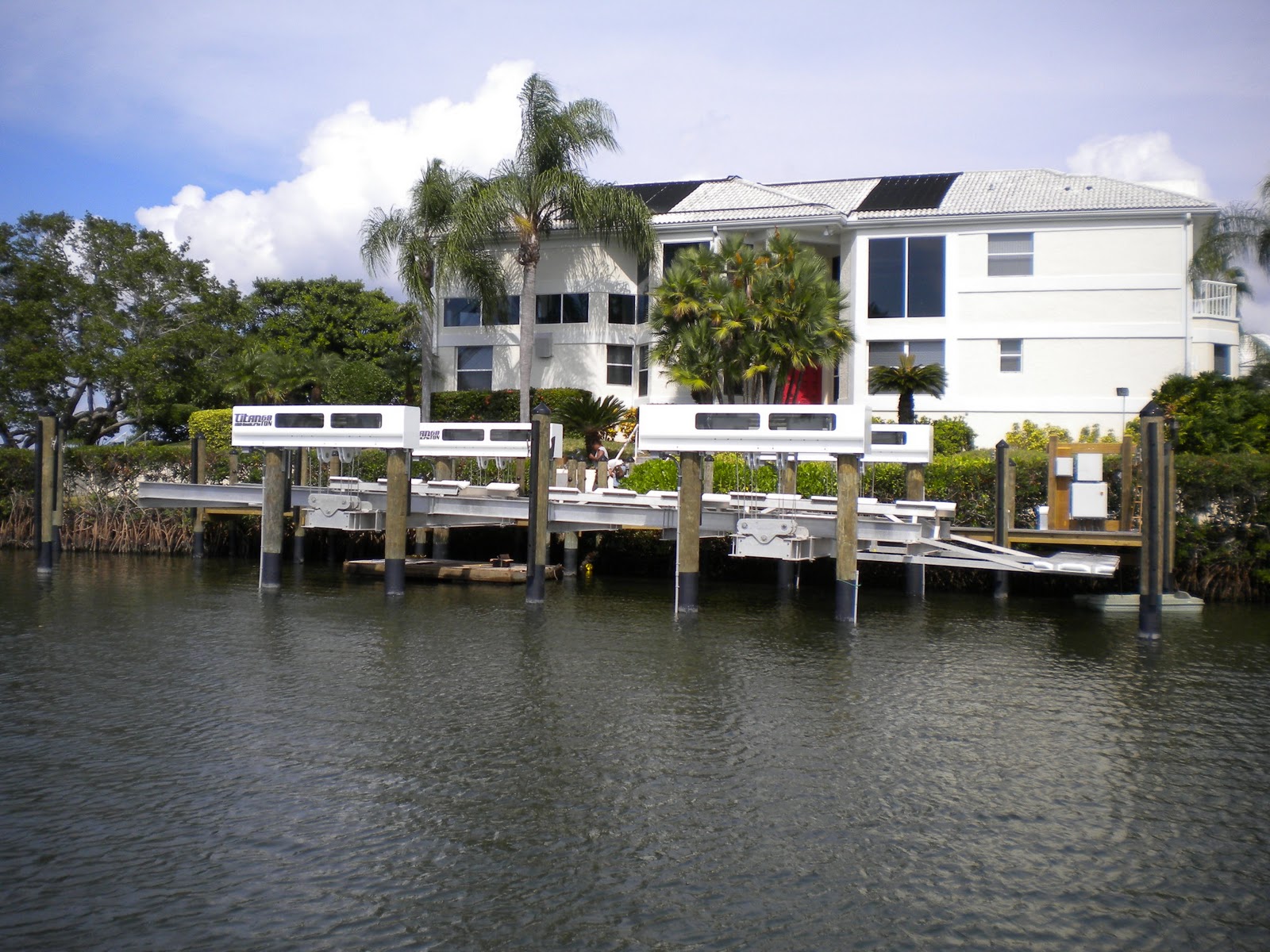
When I took the pictures, I was also very impressed with the lift, and maybe in my slightly weird techie way, I liked the lift more than the boat. The lift is a Titan 60 ton precision machine manufactured by Quality Boat Lifts in Ft Myers Florida. I spoke to Sean, who was the engineer that designed it, and the lift, like the Roadster, is a machine on a grand scale. 


The system uses 220 VAC stainless steel variable frequency electric motors, with cycloidal gearboxes to drive the lifts. With next to no mechanical backlash, the programmable speed controlled system, allows the lift to start smoothly, accelerate to speed, and then gracefully brake to a stop. This type of drive system is also used widely in larger robotic systems. In other words, this lift will place the 80,000 Roadster exactly where it is supposed to be, stop on a dime, and give you nine cents change. The motor covers are powder coated aluminum, and Plexiglas windows on the sides allow you to see the drive systems. In addition to the 60 ton unit, there are also 50 ton, and 36 ton systems, and all are available with a wireless interface, and a remote controls. You need to pick up a big boat? This is where you should go.

The Roadster, has temporarily left town, and can be seen at the Ft Lauderdale boat show, and if I can catch up with the owner, we will come back and take a closer look at this remarkable piece of boating technology.

Now come on now all of you gold chain wearing guys, you know you really want a Roadster, so stop beating me with those chains, the Atocha coins are staring to hurt.

You can see more pictures of the Roadster at Nortech Boats

Thursday, October 21, 2010

One hundred and twenty seconds


It's a cool and blustery October day on the Alligator-Pungo River portion of the ICW in North Carolina. Captain Ralph Robinson feels a bump, and a vibration that felt sort of like a grounding, but nothing serious. The boat tips to starboard, and then turns to port, just as the port engine goes to maximum rpms, and almost instantly all three bilge pump indicators light up on the dash, and the high water alarm starts to ring as well. He jumps up from the helm, runs to the aft of the bridge, looks down at the swim platform, and sees water just starting to come over it. The boat is already now 12” lower in the water, and he instantly realizes they are sinking.

He, and his mate Jay Huber run down the stairs to release the tender that is strapped down on the swim platform. They get one of the three straps released, and they are now standing in knee deep water on the platform. The tender is being dragged under by the swim platform, and the tension on the other straps is now too great to release them. Ralph asks Jay to go up to the bridge, and get the handheld VHF at the bridge station, and the latitude longitude position as well. Looking into the closed sliding glass doors leading to the main salon, he sees water rising up inside them, and a geyser of water boiling up in the center of the main salon some eighteen inches high. Ralph said of the moment, "Mental confusion abounds, and trying to make any sense out of this situation only slows our decision process".

Ralph deploys the emergency life raft right on the aft cockpit deck, just as the water starts to pour over the sides of the aft deck coamings, and scrambles into it. Hanging onto the bridge stair's railing as the yacht sinks, he maneuvers the life raft over to the port side, going from hand hold, to hand hold, using various parts of the boat, he keeps the raft  right next to the boat at about amidships. As he nears the bridge of the quickly sinking boat, he calls to Jay to give him the VHF, and the latitude longitude numbers. Jay hands Ralph the VHF, and advises him of the ships position. Ralph remembers his cell phone is on the console of the bridge, and asks Jay to retrieve it. Just as Jay grabs the cell phone, the sinking accelerates, as the boat loses all buoyancy. Water starts to pour over the bridge side coamings of the boat, which is sinking aft end first. Jay is now already nearly waist deep on the bridge, and desperately tries to reach the raft, but the force of the water rushing over the bridge is too much to overcome, and Jay is carried down with the boat. Jay tries to swim to the surface, but strikes the bimini top, over the bridge and is disoriented for a few seconds, before he gathered his wits, and swims out from underneath the bimini, through its support tubes to the surface.


Ralph had been fearfully searching around, sees a hat, and grabs it, but no hair is attached to it. About fifteen very long seconds later, Jay surfaces, and Ralph drags a very cold, and wet colleague into life raft, and out of the 58 degree river, partially filling the raft with water in the process.

In just 120 short, and adrenaline driven seconds, about the time to took you to read this far, Ralph, and Jay went from sitting comfortably on the bridge of a 59' Fairline Squadron yacht, to squatting cold, and wet in a life raft that was floating in a desolate portion of the ICW adjacent to the Dismal Swamp in North Carolina. They had no ID's, no money or credit cards, and only the very cold wet clothes on their back. The boat was now completely gone.

The VHF handheld radio was used to place a Mayday call to the Coast Guard. It was answered by the Norfolk USCG station, via repeater stations, located about 75 miles away. Ralph is very concerned about Jay's condition, who is now suffering from hypothermia, and is so cold he can't even speak, and requests that a helicopter be sent for Jay. The USCG radio operator starts to ask questions, some of which, Ralph cannot answer, such as what is the owner's address in London. The radio operator insists that no bird can be sent for Jay, until all of the blanks on the form are filled out. Ralph does not know some of the information the Coast Guard is asking for, and the radio operator will not dispatch the bird without it. Despite many requests, the radio operator will not let an increasingly frustrated Ralph talk to a supervisor.

The nearly twenty minute radio impasse is ended when the bow of a local crabber's boat nudges the tented life raft. The crabber had spotted them floating, picks them up, covers Jay with a coat, and takes them to Belhaven North Carolina. The last radio contact with the USCG, was the call Ralph made to advise them that a local boat had picked them up, and took them to Belhaven. The USCG radio operator just advised Ralph there would be an investigation about the accident.
The Pungo River


On a Sunday, just three days before the accident, a sailboat was traveling in the very same section of the ICW, noticed day marker 15 was missing, hailed the USCG on the VHF, and reported it. The USCG logged the call, but did nothing. No "Securite" announcement was made, and no further investigation was persued. The following Tuesday, Ralph was approaching the missing marker, and he was puzzled. The marker was showing on the Furuno chart plotter, well off to his starboard side, but there wasn't a marker visible.

What had happened was the day marker number 15 post was made of large welded pipe sections 12” in diameter, and a barge, or some other vessel had struck the marker sometime before the accident. With the top portion of the marker broken off, the remaining open pipe post, lay hidden just a couple of feet underwater. The marker post was actually located over five hundred feet away from its charted location, and this was verified by the insurance carrier. The 50,000 lb Fairline yacht impacted the mis-charted submerged post at 22kts.

When the yacht hit the top of the pipe at amidships on the port side under the Master Stateroom, it cut away a 12" wide, by 10' foot long strip of the hull like a potato peeler, and forced it down into the pipe.


Along the way, the pipe struck the oil pan of the port engine, ripping it free of the engine mounts, and propeller shaft, forced it upright, and drove the engine through the floor into the main salon.  Free of the shaft loads, the now holed motor spun up to its maximum rpms, and then quickly, and traumatically failed. Within seconds, the gaping hole had flooded, the engine room, and the boat was now rapidly sinking.


Belhaven North Carolina is a small town located near the mouth of the Pungo River, and is eight miles from Pamlico Sound. Another 15 miles carries you to North Carolina's Outer banks. A soggy, and cold Ralph, and Jay were dumped off at the River Forest Manor, and Marina Shipyard, and looking like a couple of homeless guys, told their story to Axson Smith the owner.

Axson immediately dug cash out of his till, and had an employee drive Ralph, and Jay to a local store, where they were able to buy some new dry, and warm clothes, and provided rooms for them at the River Forest Manor, which is also owned by Axson.

There is a round of many phone calls made to inform the owner in London, and to arrange for replacement ID's, credit cards, and cash. Getting new plastic for the now non existing wallets would take several days in this remote area, and much to both Jay, and Ralph’s pleasure, and surprise, three of the local restaurants offered to feed them on the house. The hospitality provided by the residents of Belhaven, to a couple of shipwrecked visitors, was amazing and heartwarming.

The boat was salvaged, albeit with some struggle. Divers attached lines to the bow of submerged boat, and towed it about a mile, leaving the bow out of the water on a sand bar. Working in the shallower water, and using plywood to close the large rent in the bottom, the boat was raised on the following Saturday, and towed afloat to River Forest Shipyard, where it was hauled for investigation by USCG, NC Wildlife officers, and Lloyds of London. 


The initial suspicion by the investigating groups was that the vessel must have run over a standing marker, and the captain was negligent. This notion was quickly dispelled, and Ralph was completely exonerated, when everyone could see the condition of the bow, which was without a scratch, the location of the actual hole in the bottom of the boat, and the fact that the day marker was not located in its charted location. At the time of the salvage, a strip of the boats hull was still visible stuck inside the underwater marker's pipe.

The insurance company requested, and received a copy of the USCG VHF transmission recordings. The recordings included the call by the sailboat reporting the marker missing at least three days prior to the accident, and also included Ralph's unsuccessful twenty minute VHF Mayday call requesting help. The insurance company filed a request to sue the USCG, and very shortly all matters were promptly resolved. Two senior USCG officers, in full dress whites, drove down from Norfolk, and personally apologized to Ralph, for the now removed VHF radio operator's actions, and averred that this is not the way they normally do business. The owner was given a check for the full replacement value of the boat by his insurance company.

Ralph has made a small change to his equipment inventory when he travels now. This consists of a waterproof "Jump Bag" he bought from West Marine. His original jump bag was not waterproof, and was in the main salon. In the new bag is a handheld VHF radio, Raymarine RC400 GPS chart plotter, cash, credit cards, and a Spot satellite GPS messenger. The bag is always close at hand now. Relying on the kindness of strangers is nice, but being even more prepared, is priceless.

I have known Ralph, for many years, and of all of the captains I have dealt with, Ralph is the most competent, and professional of the lot. His story is remarkable. A sinking ship, refusal by the USCG to provide aid, warm hospitality, and assistance to total strangers from the residents of Belhaven NC, and most of all, how your life can be dramatically changed, in just 120 short seconds.

Maybe all boaters owners should take a couple of minutes to inventory their safety gear, and mentally run through what you would do, if this happened to you.


If you need the services of a high quality captain, you can contact Captain Ralph Robinson at his e-mail address capt_ralph400@yahoo.com


The photographs of the salvaged vessel were graciously provided by Axson Smith, the owner of the River Forest Manor and Marina. This is a good place to stop on your travels down the intercoastal waterway.


The photo of the Pongo river is from the blog Scooters Voyage.

You can learn more about picturesque Belhaven NC here.


You can find out more about the Great Dismal Swamp here

If you came here on a direct link to this article, you can find my other articles in the archives to your right, or you can see the current articles here on my home page, thanks, Bill Bishop