Sunday, September 19, 2010

Combinatoric permutations of Shackleton, his whiskey, and the NZAHT

"I thought you'd rather have a live donkey than a dead lion."

Ernest Shackleton's comment to his wife Emily, regarding his failure to reach the south pole.


I couldn't resist starting off with a hundred year old case of scotch whiskey discovered frozen under the floor of Ernest Shackleton's Cape Royds hut in Antarctica in 2006, but this is only a small, but fun part of the story.  I will return to the whiskey a little later. The real story is about the early Antarctic explorer's bases, and the historical restoration that is occurring, in this remote, and getting less remote part of the world. As the title indicates, the subject matter will move around as it suits my whims, and I'm going to leave a good trail behind for you to explore further.


I have chosen Ernest Shackleton as the focus, because many boaters are familiar, in particular with his audacious 800 mile small open boat journey in the "James Caird" (actual picture of the launching is above), with five crew members from Elephant Island (just off the coast of Antarctica) to South Georgia Island where a whaling station was located, and thus saving all of the crew from the ice trapped Endurance. This and Captain Bligh's 3600 mile small boat trip, are two of the most epic events of this type ever recorded.


Shackleton was one of the major players during the "Heroic Age of Antarctic Exploration", and participated in four expeditions. The  first expedition was as a third officer on the Robert Scott Discovery Expedition (1901-1904). Shackleton contracted scurvy during the expedition, and was sent home early in 1903. Shackleton was the leader of his second expedition, the Nimrod Expedition (1907-1909). This is my favorite expedition, because it reminds me of the Apollo missions to the moon. His third expedition is the well known Endurance, or Trans Antarctic Expedition, (1914-1917) which ended early, and well, meaning no lives were lost, because of Shackleton's epic trip to save the crew in the small  James Caird. Shackleton's last expedition was the Shackleton Rowett Expedition (1921-1922. Ernest Shackleton died of a heart attack while on board his ship in January 1922, and thus ended the "Heroic Age of Antarctic Exploration.


Okay now, just bear with me a little longer, and we will have some fun. Who owns Antarctica? The answer is a lot of countries have territorial claims, but in essence no one. The continent is open by treaty, to legitimate scientific investigation. There is no mining, industrial, or military activity allowed on the continent.

For over 50 years now New Zealand has taken care of the historical Antarctic sites located in the Ross Sea area. In the late fifties attention was drawn to the condition of the early expedition outposts, and some attention started to be paid to these historic sites. By 1960 a more formal plan had been drafted to undertake restoration. The New Zealand Antarctic Society had primarily managed the historic  restoration efforts, but never quite had the needed resources. The New Zealand Antarctic Heritage Trust was founded in 1987, and has managed the restoration activities to date. Since then Shackleton's hut has been mostly restored (work will always be ongoing), and over 5000 artifacts from the site have been added into the Shackleton collection. Activities are well underway at other sites, including Scott's hut. I don't need to remind you that work at these sites is part time. I understand the winters are a tough time to work outdoors, and the summers don't always have to be kind.


Above is a more contemporary view of Shackleton's hut, after a great amount of effort.

Okay, lets have some fun now. It's Whiskey time! This is a very small part of the conservation effort, but the massive publicity over finding a case of 100 year old Whiskey, in the Antarctic of all places, had to have provided a welcome boon to the NZAHT's conservation efforts. A documentary film is being made, and who doesn't like a good story over a whiskey, or about whiskey? I averred to one of the conservators that it is their story to tell, and here you will find a terrific bog written from the "Whisky" conservator's point of view, and with great photo's titled The Great Whisky Crate Thaw. On the same  subject, I tried to dig out some information from Richard Paterson, who is Whyte & Mackay's master blender, but he was somewhat reticent to discuss how he could recreate the whisky, if he had a sample. It is not clear that he will get one, but I know he sure wants one. You can get more information about this subject at Whyte & Mackay's "Master Blender" page. Yes the company that sold Shackleton the whiskey is still around, or more correctly, Whyte & Mackay owns the label (Mackinlays Rare Old Highland Malt Whisky).

These early ventures were truly scientific ventures, and a great amount of expense and effort went into planning and outfitting these expeditions. Remember when I mentioned that the Shackleton Nimrod expedition reminded me of the Apollo moon missions?  Both Shackleton, and the moon astronauts took cars along on their expeditions. Shackleton's car never performed up to expectations in the harsh Antarctic condition's, but it was the first auto on the continent.


One of the most interesting parts of looking into this meandering missive, is the large amount of documentation there was to pour through. One of the most interesting things I found was at the NZAHT's website, and is the provisioning list for the Nimrod expedition. Amazing to say the least, right down to the prefabbed hut.


Above is a photo of Nimrod expedition explorers in the hut.


I'm not the only one to spot it, but you can see next to the clock, a large advertising flyer for ladies corsets with a young lady pictured sporting one. No doubt in my mind, this is the same type of "Pin Up" that is in my mechanics garage, except his is far more scantly dressed, if at all. I wonder if the flyer it is still around? It is listed on the Nimrod expedition "Provisioning" list link above.


Another fun Shackleton tidbit is this ad that has been floating around for years. Many scholars have researched it, and it is a fake.


I spotted this cute dingy a couple of days before I started to assemble this story. I asked the owner why it was named the James Caird II. He stopped, smiled, and said "Because Shackleton owns the James Caird I".

A last couple of thoughts. I think the NZAHT should give Richard Paterson a wee few drams of the whisky, for a price, and a cut of any sales generated from selling Shackleton's/Mackinlay's whisky. Shackleton won't miss it, and the revenue stream from sales can be put to good use on other projects. Also, if you give him a sample, do a real analysis on the contents. Richard can nose it, but good sample analysis should be done, and Richard, if I have had anything to do with getting you a sample, send me a case of the new Shackleton whisky, I will pay the NZAHT royalties portion, and the freight.

And for the historians, what ever happened to Shackleton's car? I could only find a few obscure references that mention it being donated to a museum. Could it still be in Antarctica, hidden in a snow drift?

Some good links:

Want to see Shackleton's hut? about 900 people a year do, and an expected 80,000 people will visit Antarctica this year, and this is one way to get there.
The New Zealand Antarctic Heritage Trust An excellent site worth spending time at, and they always need help, fiscally at any rate.
The Canterbury Museum The "Whisky" conservation is being done there.
Want to see what Shackleton's hut looks like right now, visit the Penguin Cam at Cape Royds
Lots of Antarctic links here

Saturday, September 18, 2010

Meet Steve Padar

One of the most important lessons I have learned in life, is that everyone has a interesting story, if you stop talking yourself long enough to listen, and boaters always seem to have more interesting stories than most. This is the first, of a intermittent series of stories about some of my clients.

So let's go meet Steve Padar. This is Steve's backyard, and his boats. He has, a small Scout center console, and in the background, his Grady White walk around. He had a third boat on blocks in the back yard, but I suspect in order to maintain martial bliss, he was advise of the right answer to the question of "When is that boat leaving the yard?", and it is now gone. Do you see that rounded structure to the right, that is a telescope dome. I met Steve when he requested a little help with installing a Raymarine weather receiver for the Grady White, although he was more than technically capable of doing this himself. 


When I first visited Steve's house, and while walking up to the front door, my keen powers of observation told me there is something different about this house.


And also in his backyard, you quickly develop the opinion, that Steve is doing something more than trying to receive blacked out football games on the sly.


So here is Dr. Steve Padar, from Sarasota Florida, who in real life is a practicing neurosurgeon, and he graciously allowed me to see his metaphorical man cave, and what a technological wonder it is! 


Everywhere you look, there is something to see. A full wall of floor to ceiling books, and racks of equipment everywhere. Behind this equipment wall is a long desk with two very large flat screen monitors, and a half dozen computers under it.


Another large desk is packed with lots of ham radio gear.


Wiring galore everywhere. These bundles are the feeds from the exterior antennas. 


And lots of Ethernet connections tying systems together.


So what is this room all about? In addition to being a ham radio enthusiast, one of several of Steve's hobbies is the acquisition, and direct down loading of weather photographs from NOAA's satellites, and this is not a trivial task. The pictures below are from the GOES 12, and 13 satellites. These are geostationary  satellites parked over the equator at 75 degrees W (GOES 13), and 60 W (GOES 12), and they were being downloaded as I watched.  


These photos were downloaded on Sunday, September 5th around noon EST. In the full frame picture, you can see hurricane Igor, and behind it, you can see the tropical depression, that will become hurricane Julia. My camera does not do the quality of these pictures justice.


Above is a better view from GOES 12. You can see Igor clearly, and Julia to be, is just off the African coast. Although it takes substantial technical acumen to receive these photos from a geostationary satellite, Steve's equipment can also receive photos from weather satellites moving in orbit. This takes another level of technology. You need software that will provide you with Mr. Kepler's orbital data predictions, the antenna axes kinematics have to be programmed to intercept the track, and match it. The satellite signal has to be programmed into the system to receive the signal, and if this wasn't enough, as the satellite approaches you, and then moves away, the signal undergoes a Doppler effect that shifts the frequency, and the receiver has to compensate for this shift. This is a very simplified explanation of a very complex process.

Steve's equipment can receive frequencies from 50 kilohertz to 2.4 Gigahertz, although to be technically correct, he can't receive every frequency in this range, but he does handle a good swath of it. Amazing, and technologically stunning to say the least, and all of this hidden in plain sight in a lovely bay front home. 

We're not through yet. As if this wasn't enough, Steve's other hobbies are travel, boating, diving, and photography, and he excels at all four. He has traveled all over the world with his camera, from the Antarctic peninsula, to the North Pole and many locations in between. Diving in Truk lagoon, the Galapagos Islands, the Australian Great Barrier Reef, and many other exotic locations, and taking magnificent photos along the way.

I mentioned that Steve visited the North Pole, something that most of us will never do. He traveled there on the Russian icebreaker the I/B Yamal. This is the pride of the Russian icebreaker fleet. It is just shy of five hundred feet long, and is powered by not one, but two nuclear reactors, and weighs nearly one million pounds. This ship will crunch some real ice, and real ice had to be crunched to get to the pole. Only about a dozen trips by ship have ever been made.

As a footnote to the story, I was looking for a picture of the I/B Yamal, and you are looking at it above. The picture was taken Aug 3rd, 2001 while in route to the North Pole. In the picture, of the not easy to get certificate below, there are three notable things about it. The location is 90 degrees north, you can only get it if you have been swimming at the North Pole, and it is dated August 5th 2001. So Steve is actually on the I/B Yamal at the time the picture was taken. 


Now you have met Steve, doctor, neurosurgeon, boater, traveler, photographer, diver, and intensely curious about the world around him. I know he will demur, but he is a modern day renaissance man, and an extraordinary, and gracious person to spend time with. All of us have a bucket list. I think Steve's bucket is really a fifty five gallon drum and still mostly full. I am working on being a better listener, and thank you very much Steve for the time you spent with me, it was most enlightening, and pleasurable.  

You can see some of Steve's terrific photography here. You may need to download the Photodex.com viewer to see the shows. Check out the Antarctica, and Truk Lagoon slide shows, but there is much more to enjoy here.

You can learn more about the Ice Breaker Yamal here.

The Photograph of the I/B Yamal is from Wikipedia commons, and was taken by Wolfratz

Saturday, September 11, 2010

So you really think you own a fishing boat?


"Houses are but badly built boats so firmly aground that you cannot think of moving them.... The desire to build a house is the tired wish of a man content thenceforward with a single anchorage. The desire to build a boat is the desire of youth, unwilling yet to accept the idea of a final anchorage."

Arthur Ransome
Racundra's First Cruise, 1923

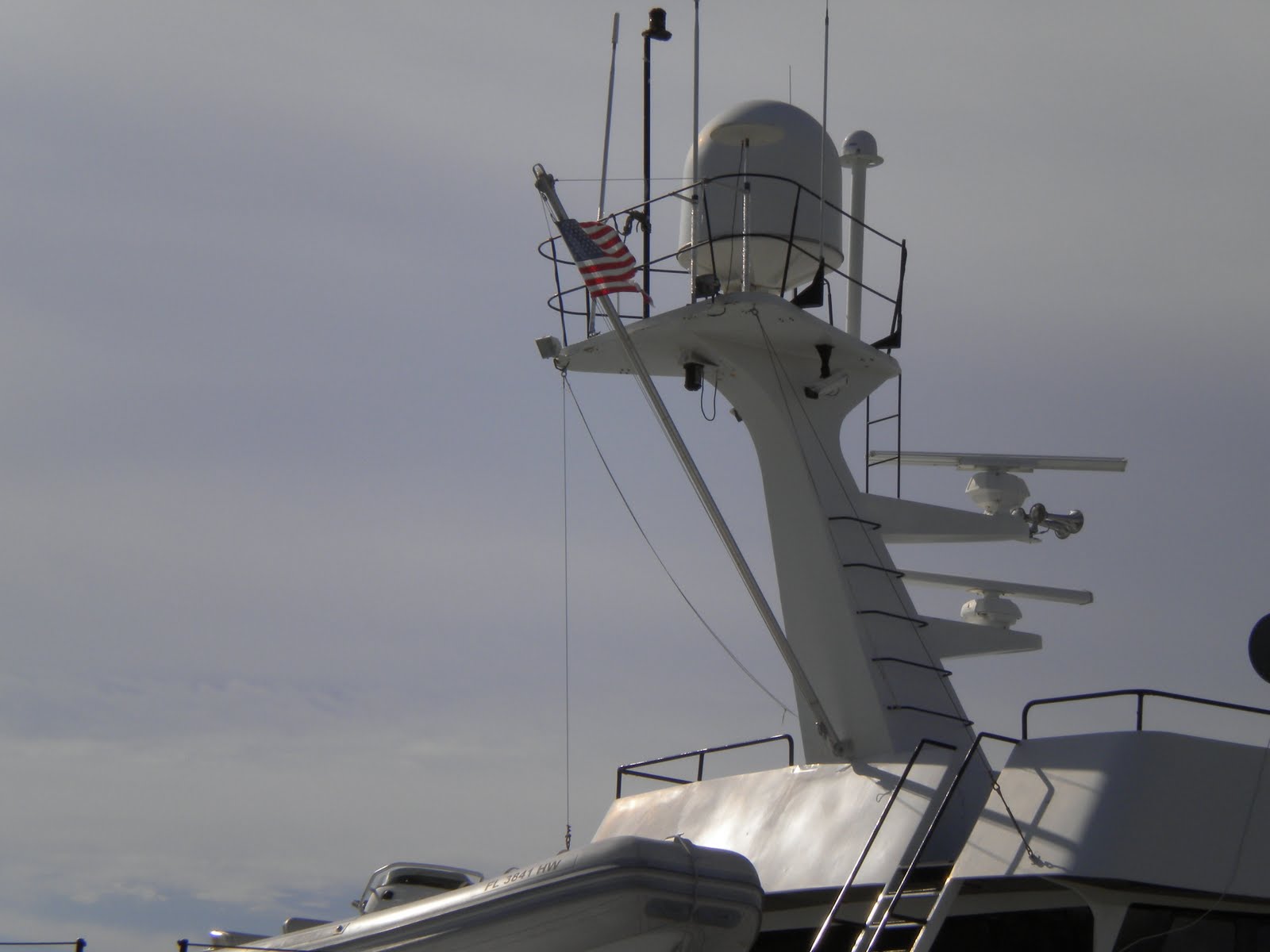
This is a little photo essay about the vessel "Melia", and I have had an unrequited love affair with this vessel for a long time. I have not been on board, or met the owner, but I will lurk around until the opportunity presents itself. You can see her in the picture below, at the end of the dock in Sarasota's downtown marina. That is a 100'+ Westport yacht in front of her, and the Melia towers over it. When I used the words "fishing boat" in the title, I was being specious, Melia is truly a ship.


The steel hulled vessel has a foc'sle on steroids, and looks like it could take almost any seas I could imagine.


The aft deck has a substantial hydraulic davit system,


and there is no shortage of electronics on the mast including dual open array radars, satellite TV, Sat phone, and multiple communication antennas.  


An over sized RIB sits above the aft cabin, and behind the wheel house.


It almost looks like a fancy work boat, and it is, in a recreational sort of way.


But now you find out what the over sized davit is for. The vessel carries a 33' Intrepid center console fishing boat on its back deck. I suspect this vessel carries its owner to places the rest of us could never get to, and launches the Intrepid to fish in waters that would be virginal from a fishing viewpoint. How do I love this boat, let me count the ways. 


Playing the game, if I had some ham, I could have a ham sandwich, if I had some bread, below is the vessel Kate and I would own, if we had the bucks. Anyone can have a white plastic boat that looks like a hotel on the inside, I find this vessel infinitely more appealing. Eight kts is fine with me. 


To learn more about these Jay Benford designed boats, visit Florida Bay Coasters

A day in the life, the installer goes to Garmin school.


Woke up, fell out of bed
Dragged a comb across my head
Found my way downstairs and drank a cup,
And looking up I noticed I was late.
Found my coat and grabbed my hat
Made the car in seconds flat.

"A day in the life" Sgt Peppers Lonely Hearts Cub Band, circa a long time ago, and slightly stepped on

This is how my day started on Tuesday. Up at 3:00 am, out the door at 4:00 am, drive from Sarasota to Dania Florida (Ft. Lauderdale), grinding through the Miami rush hour traffic in a driving rain storm clutching a map, and arriving at the International Game Fishing Association museum at about 8:30 am. I want to dispel that ugly myth right now, that your installer's days are spent drinking Pina Coladas, and going for boat rides, while charging fees that would make a brain surgeon envious.


So my school day starts at 9:00 am at the International Game Fishing Association's museum, where Garmin has arranged the meeting rooms for the day. I suspect the location selection was not an accident, and it sure beat the meeting rooms at the local airport hotel. The IGFA facility is a stunning modern building, and as you can imagine is filled with world record fishing memorabilia. Garmin representatives check you in, and point you to a buffet filled with bagels, rolls, fruit, and lots of hot coffee.


I was pleasantly surprised at how many installers were there to take the class, and the large number of Garmin staff that were available during the presentations, most of whom were technical staff, although a couple of senior sales staff were present to keep an eye on the technical staff, or was the technical staff there to keep an eye on the sales guys?


Oy vey! do you see the size of the book, and I have to learn all this today? Actually the book is worth its weight in gold. It contains almost every installation manual for Garmin marine products, and a wealth of other technical, and product information. The contents are also on a CD inside the book.


So off we go at 9:oo am, and John Murch does most of the primary technical presentations.
It was a fast paced presentation, with the presumption that everyone in the room had a Garmin installation background baseline. The thing I liked best about John's presentation, was the interactive aspect. If you stuck your hand up, and ask for clarification, or a question, things stopped, and you got an answer. If John didn't know the answer, and it wasn't often, the other Garmin personnel either knew, or were on the the phone, and or computer, and you had the answer ASAP. This format kept the presentation lively, and interesting.


The day relentlessly goes on, there were breaks to refill your coffee, and lunch was provided (the lasagna was bland, and I wished there was some Tabasco to be found). From Chartplotters, to sonar, to radar, a terrific autopilot presentation from Robert Archer, one of the original TR-1 personnel, and software. No Garmin technical subject was left out. There was also virtually every marine product Garmin sells on display to play with.


All of a sudden it is almost 5:00 and it is test time. Seventy five questions later, (I missed three, semantics are everything), you are given the grand prize. The Garmin technical, and good house keeping seal of approval.


I leave at about 6:00, arrive home at 10:00, let the greyhounds girls out, had a bourbon, and passed out.


The following morning, I bestowed some of my new intellectual largess on a client, who had been having some particularly vexing issues. Using one of the hidden diagnostic screens I had learned about, I found a vital clue about what was happening, and shortly the problem was corrected. You can teach an old dog new tricks. 


With thanks to Joe Cornwall for the use of the IGFA mueseum photo, Joe is the webmaster of the Fly Fish Ohio website.

Sunday, September 5, 2010

The BitterEnd Blog


I have added the BitterEnd blog to our link list. I have been reading it for a while now, and after spending the better part of a day reading it, and not yet finishing, it, and I will, I am more than pleased to suggest you check it out. Good blogs are not common, and this is one of them, with some humor, and eclectic items of interest. Captain Richard Rodriguez is the primary captain for Assistance Towing located in the greater Seattle area and operates in the Salish Sea. He has provided assistance to well over over a 1000 boaters, and if that doesn't keep you busy enough, He provides training through the 100 ton Master's course.


A day in "Captain Rodriguez's" life

At approximately 11:00 on Sunday July 24, 2005 I finished fueling the tow boat, a 26’ Shamrock, at the Port of Friday Harbor and was reroute to Roche Harbor. About 200 yards off the main breakwater I noticed a 12-14’ Zodiac with no registration numbers and no name. I took the dingy in tow on my port quarter.


I called the boss and asked where to take the dingy. He indicated that it should be tied up at our facility. My next call was to Coast Guard – Group Port Angeles to report that I had an unoccupied dingy in tow and was taking it to our base. I was making 5 knots, and reported that the engine was down and it had a blue towel on board. I also reported that it had about an eight foot painter. I indicated that once the vessel moored, I would look for the HIN #, call them back and make a report to the San Juan County Sheriff.


About ¾ of a mile from the Friday Harbor breakwater I heard some shouting that the dingy was theirs and that I had stolen it. I said that I had salvaged the dingy and had made a report to the Coast Guard. My next call was to the Coast Guard Group Port Angeles to report that a vessel was indicating that I had stolen the dingy and I wanted to confirm that they had a record of my earlier call. The Duty Officer indicated that they did.


As the 48 foot Sea Ray came along side. I indicated that I had salvaged the vessel and was proceeding to Shipyard Cove. I indicated that our minimum charge was $150, and the woman aboard the vessel became enraged. She indicated that I had stolen the dingy. I restated that if I had intended to steal the dingy I would not have reported it to the Coast Guard. I suggested that they call the Coast Guard to confirm my story.


The male aboard the Sea Ray asked if I could come along side and settle. I indicated that I didn’t have much time wrapped up in the salvage and would accept $100. The woman with a credit card in hand asked if she could come aboard. I figured that she was offering to pay.


At that point she crossed over my boat and onto the dingy and proceeded to untie the two vessels. I told the woman that she was welcome to speak with the Coast Guard and I would place the call. I called, handed her the phone and she yelled that I’d stolen the dingy, and would not return it.


What then ensued was a sort of tug of war, her attempting to untie the dingy from my vessel and me attempting to retie it. During the untying and retying she stated that she was an attorney and would sue me. I insisted that Maritime Law was a bit different and that I was entitled to compensation. During that time the three vessels were drifting close to shore and the male asked to just pay and they would be on their way. As the three vessel drifted closer to the dock the male untied his boat from mine.


As the tying and retying continued, the woman reached up and pulled off my glasses. I said that if she was an attorney she would know that she had just committed assault. I asked for my glasses back. She said that if I would release the dingy she would return the glasses. At that point I asked the folks on shore to call for the Sheriff.


As the deputies arrived, they asked us to come to the dock. I untied the vessel and came to the dock. The woman could not get the dingy started and insisted that I’d done something to it. I stated that I’d never boarded that dingy. She then drifted to shore.


Each of the parties then proceeded to relate their versions of the incident to the deputies. My boss showed up and related to the male that indeed we were entitled to compensation and could claim a percentage of the value for the dingy.


He then asked me what I wanted to charge, and we settled on $200 which was charged to a credit card.


The man profusely apologized for the actions of his wife and they were on their way.

and...


Random drug testing, if you're that sick, you need to see the doctor, and...


tribulations.....

It's a good read, and as Ken E. Beck proffered about my blog, if you don't like it, I will give you your money back. Tnx Bill

A Formula 330SS update story, you can always make it work, you just have to be inventive!

The moral of this little story is that almost anything is possible, if you do some creative thinking. Hard work, and a little luck is always helpful also. The subject is an 2005 Formula 330SS. It is a pretty boat, with a large cockpit, and nice hull lines. The new owner is a nice guy, and I think he purchased it for a good price. I was originally contacted to update the electronics. The owner had very carefully measured the space available for a new chart plotter, and had purchased a new Garmin 4210 unit. It will fit, and I mean just fit into the console. He also bought a new transducer, GSD22 sounder module, GXM51 weather receiver, GFS10 fuel flow sender, and a Garmin 100 VHF (boy I wish it was a N2K unit). He also wanted a autopilot, and I said no, possible, but no. My reason for saying no was two fold. The first was the boat was cable steered, (I/O) and the second was there was no room in the engine room for an over sized linear drive, or anything else, so sorry, no.


A few days later, I get a call from the owner, and he tells me the engines are being removed. Is an auto pilot possible now? The answer is now yes, and we will now buy a Garmin autopilot system.


With the engines removed, and the hatch off, the compartment now feels like the boat equivalent of being on the open western plains, and I can now almost feel the winds sweeping down, and see the big skies. Room galore, everything is accessible, and in installer terms, sheer heaven. 


The first task is to install a new transducer. With the engines in place, the options would have been very limited, and the task difficult. At the same time, the AC water pump was mounted under the generator, and looked pretty beat up, so the AC guy removed it and put a new one in under the hinged panel, making it accessible, and installed a valve to boot to break any airlocks (the boat lives on a storage rack).

The boat had a cable steer Teleflex system, which had to be removed, so it was detached from the power assist steering pump, and back pulled up to the helm. It took some real gyrations, and effort by two of us to get this 25' cable out, because at install time, it was tie wrapped with other wiring inside the combings. Who would have every thought it might break, or need to be replaced in the future?


Teleflex makes a special hydraulic cylinder to replace the cable steer system, and here is the catch. You can see the the cylinder, now attached to the power assist pump in the picture, and the outboard end is now about five inches from the hull. To install it, the whole power assist module, had to be removed in order to slide the shaft into place. Easy now, impossible with the engines in place. And as a personal note, many thanks to Marc Adams from Teleflex for his patience, and most excellent advice. It was most appreciated.


Now on to the hydraulic helm pump. The steering system attached to a round fiberglass protrusion formed into the console. If the new helm pump was just mounted there, the helm would have stuck straight out. This would have been both ugly, and awkward for the driver. As an additional point, there was not enough room behind the console to use a tilt helm unit.

Teleflex makes a 20 degree mounting plate, but it has a square mounting flange, and would not fit in this location. So, when you look at the picture above, the 20 degree angle piece, that the new helm is attached to, is the plastic housing from the old cable steer system. I took "all thread", and cut four new long custom mounting studs, and epoxied the old steering base to the new helm pump. Just so there is not any wincing from my colleagues, the plastic base actually fit, with some minor carving, pretty tightly around the new studs, and the epoxy was more to hold it in position, than to attach it to the new helm. It worked a treat. The fall back plan, would have been taking the other 20 degree aluminum mounting flange to a machine shop, milling off the flange, drilling holes in the top, to allow long bolts to attach it, and did I mention the whole part would then have to be stripped, primed, and repainted? I think it all worked out great, and looks good.

The hydraulic plumbing was a real pain. There was little space behind the steering system to install the hydraulic lines, and despite my best efforts at planning ahead, it took three trips to a large hardware store, to end up with a configuration that would work.


There are now two problems left to go. Yann, my new aide, is now removing a vinyl padded trim strip from the boat. The new Garmin VHF radio's foot print is much larger than the old Standard Horizon VHF, and so it goes bye bye.


The solution was to take 1/2"  white acrylic, and have it milled to the same shape as the original vinyl panel, with a curvaceous lower extension to allow the VHF to be flush mounted. Good looking, and it closely matches the original panel.


The time for final battle has come, and the one I was dreading the most, installation of the Garmin 4210. The original panel where the Garmin was being mounted had a 1/4" aluminum wood grainy looking panel, that matched the the other panels in the console. There were two problems with the panel. The first was at the bottom of the panel, there was some oxidation occurring, and it wouldn't be long before the wood grain looking stuff started to fall off. The second problem was when the hole was cut out in the panel for the Garmin, there would be very little panel left. I was less than confident I could cut out the panel myself, and option number two was to take it to a machine shop, and have a milling machine do the cut out, and time was of the essence.

The fall back was to have a gray acrylic panel made to take the place of it. When the panel cut out was made, there was little left, but it looked good. 

So attach the plugs to the unit, and set it in place. I already knew what was going to happen. The plugs stuck out too far from the back, and it missed seating all the way down by about 3/8'. Although I knew the answer, I called Garmin, and inquired it the were any shorter plug options, and I got a terse no.

So when depth fails, a sharp utility, and a band saw prevails. Step one. The worst depth offender was the marine network plug for the GSD22. I cut off the old plug, and took a new field replaceable plug, and lopped off about a 1/2" on the band saw, and threw away the spirally thingy that came with it. I re-terminated the cable, and had a 1/4" to spare. Now the power cord. A utility knife carved away the upper part of the wire sheathing until we got to the place where the wires were molded into a white plastic material. This allowed the two wires to bend over without straining, and the second problem was solved. Just a little carving on the N2K connector, and the unit fit, without cramping the wiring. The last step was to tab the corners of the unit with silicone to hold it in place. It was not possible to bolt it in.     


It looks good doesn't it? Everything is factory appearing. The auto pilot head, at the owners request went into the location where a pitot tube driven speedometer was located, and there really wasn't any other place for it to go.

There is a wart. The Garmin 100 VHF only has the old NMEA 0183 interface, and there was no way, the huge NMEA cable was going to be carved back to fit. There is, theoretically, some space behind the console, and a cut out might be possible to allow this cable to work, but the boat is going on a trip, and I was happy to have gotten done, in time at all. 

All in all I am pleased with the work, but it was the most fiddly job I have done in a long time. A lot of stuff, crammed into spaces that they were not designed for, and it seemed everything needed some  modification.

And to all of you chart plotter makers, It is not a contest to see who can make their plugs stick out the furthest. Shorter is always better, or at least sell me 90 degree adapters.


A final look at the engine room with the engines installed. Everything looks brand new. It is spotlessly clean. I wonder if I could train spider monkeys to work in these tight quarters? No, they would probably just complain it was to hot, and cramped to do the work, and go back to the organ grinder.