Showing posts with label Garmin. Show all posts

Sunday, February 15, 2015

Ruh-roh! Transducer transplant time.

"Can you install these transducers without a fairing block?" I was asked. "I don't know, what transducers?" came my muffled squawk from the interior bowels of the boat. Let me climb out of this god forsaken  hole and take a look."

My response was, "Sure you can install them without the fairing block, if they are pointing straight down. But these aren't level, not even close to level. Who installed these things?" The factory was the answer. The fairing blocks were still in the box along with the apparently unread instructions. This was Thursday morning and the boat was delivering Friday afternoon. I still had a lot of other things on my do list like finishing the autopilot and the security tracking system. What is the art of the possible in this case? Not much methinks. A plan is needed.


Thursday, July 31, 2014

Installing the Garmin Side and DownVü through hull transducers

The Garmin Down/SideVu through hull transducers come in two versions. One looks left, right, and down in a single transducer (deadrise of 5 degrees or less and does not require a fairing block). The ones I'm installing are a pair. The port side transducer just looks to port, and the right side transducer looks both down and to the right (deadrise angle from 5-25 degrees. The kit I used consisted of the transducer pair, two fairing blocks, 2 anti-rotation bolts, bushings, washers, nuts, pigtail to connect the transducers together, twelve pin transducer cable, and GCV 10 with a power and network cable. In sum all of the hardware you need is supplied. Let's get messy!


Friday, December 13, 2013

Verado/Uflex Autopilot Hydraulic Plumbing DIY 101

Installing a autopilot with a Verado or the Ulex equivalent steering system is not difficult, but it does come with some nuances. These systems come with a proprietary high pressure power steering assist pump, and helm pump. Despite this, the plumbing is pretty straight forward, but the fittings and hoses are different. In this case we are installing a Raymarine system, but the process is similar for the other systems.


Sunday, May 19, 2013

You haven't come a long way baby.

"Frank, long time no hear, what's up?" "I need a GPS Bill, I'm maybe thinking about racing one of my boats in a new class." "Okay I guess, but's what's wrong with your Garmin 545?" "It doesn't meet the rules Bill?" "What do you mean it doesn't meet the rules, does it need to be newer?" "No, it has to be older. The rules say," The following is the SBIP APPROVED LIST OF GARMIN GPS’S 172, 172C, 178, 178C, 182, 182C, 188, 188C, 192, 192C, 198, and 198C. "Crimniy Frank, none of these are even manufactured anymore."


Tuesday, April 16, 2013

Boats that spread their wings

Just as soon as the Wright Brothers figured out how to get an airplane off the ground, inventors were trying to get them to work on water. The first successful float plane flight was in the flimsy looking Le Canard in 1910. By 1923 short hop commercial flying boat service became available in Britain.

The pinnacle of commercial flying boat service was the iconic Pan Am Pacific Clipper (Boeing 314) starting in 1939. Service ended in 1941 with the US entry into WWII. The introduction of the Lockheed Constellation and the Douglas DC-4 rendered large commercial transoceanic and flying boat service obsolete. None of the Boeing 314 aircraft exist today. The last one was scrapped in 1950.

Here is the vocabulary. Seaplanes can take off and land on water and runways. The subclass of this genre is amphibian aircraft. They divide into floatplanes, and flying boats, with the later being defined as having a hull. What you're looking at is a sleek Seawind 3000 flying boat, and you have to build it yourself, or at least more than half of it. You can also buy one someone else built and had certified.


Saturday, March 9, 2013

Splitting the transducer

The Parmain top secret laboratories have been bombarding a transducer with protons trying to get it to split. The DARPA program funding was pulled when the janitor said, "Just add a wire pigtail to the transducer, it's simple." Drat, time to write another grant request to DARPA. Maybe this time we could design a talking GPS for a boat. It should be simple enough for the average boater to use. To guide you to your destination it could say "Colder" or "Warmer." If you lurch to a stop it will say "Freezing."

Of all of the electrical things that exist on a boat, your transducer is the most reliable. It's always immersed in a salty chemical soup, gets dragged through the water often at very high speeds, and yet it keeps on working year after year. When I get a call dealing with a "no depth reading" problem, the first thing I suspect is the depth finder itself. Second could be the transducer face is covered with marine life having a rave party, and or has gotten knocked up. Third is damaged wiring. Fourth, and only very rarely the transducer has failed. There is an exception here. If it is a Garmin system, it may be suffering from thermistor-itis.


Tuesday, February 19, 2013

Miami boat show 2013 roundup

The numbers aren't in yet for the Miami boat show, but by looking at the crowds on Friday, and the struggle it took to park, I think it is going to be a well attended show. My day was marred by rain especially in the afternoon which stopped me from visiting the "In the Water" venues. As I expected, new marine electronic product introductions have taken a big leap. My favorite was the new Raymarine Dragonfly sonar, a take on the Navico "Structure Scan", but using CHIRP technology with the brand name DownVision. With a price of about $700 I was extremely impressed.

This just fortifies my sense that we have just barely scratched the surface of sonar CHIRP technology. Just imagine this technology looking forward for obstacles, and being able to show you a safe path through shallow waters, or warning "Danger your boat can't go there!" Just musing out loud.


Sunday, July 22, 2012

Radar overlay heading gyrations

This all started with hearing a rumor about a boat accident, that led to a lawsuit. This caused Raymarine to turn off their system's long existing capability of using GPS generated course over ground data as the radar overlay heading input. This was reinforced by Compass Marine's rant on Panbo that was similar to what I heard.

So I explored the issue, and was initially confused by what I was finding. There is the recently settled patent lawsuit that involved almost all of the big MFD manufacturers. It appeared that since there were aspects of the case that could have involved radar overlay, this could be the culprit. In the end this was not the case, and it was settled by all parties in American GNC's favor.

As for the rumored boat accident, I just couldn't find it. The one that was closest to the described accident was wrapped in somewhat of a mystery. Despite the fact that three souls were airlifted off the vessel, there is zero reference to it in the USCG records. There were lawsuits, but I could find no information regarding them. In the end I had spent way too many hours looking, and I picked up the phone, and called Raymarine.


Friday, May 11, 2012

Shallow water chirping

You hear the claims that chirp technology lets you see deep, and here is some real proof. A Garmin GSD26 with an Airmar 599LH transducer painting the bottom at an impressive 11,706 feet. That's over two miles deep. I think this is the current record for finding bottom with a marine chirp fish finder, or at least this is by far the deepest screen shot I have seen to date, and I have seen a lot of them. Look at the depth range scale. The bottom of it is at 13,200 feet, and I would bet given time we will see even deeper screen shots if anyone can find water deep enough. I'm sure the unit was using every bit of its 3000 watts on low chirp to do this. But this time, we are going to the opposite extreme to look at how well this technology operates in very shallow water.


Saturday, March 31, 2012

Andren waypoint format conversion magic

It's time for the"Dark Arts." On goes the robe and conical hat with the stars and moons. A quick check tells me the goat is prepared, and out of assorted secret chests various magical implements are extracted.

Today we are casting a difficult, and dangerous spell to exorcise the waypoints out of an ancient Garmin 215 chartplotter, and whisk them into a newly installed Garmin 7215. For those who are afraid of such unnatural, and "olde magicks", you should stop reading now, lest your soul inadvertently gets sucked into the black technical vortex to suffer for all time. For all else, have your garlic and amulet close at hand while you read.
   

Tuesday, February 21, 2012

Installing the Garmin GSD 26

It's large, heavy, and packed with high resolution analog to digital converters, and a dual core digital signal processor (DSP) system. Although installation is fairly straight forward, there are some nuances you need to deal with when wiring the broadband transducer into the box, as I have learned.

Tuesday, January 24, 2012

Film at 11:00

Borrowing Mr. Well's time machine, I roar on back to the year 2003. These were heady times. The Installer put in all of the gear you see below into a new Pursuit. It included the new Raymarine HDFI sounder module which won the "Best in Show" NMEA award that year. The RL80  state of the art chart plotter and radar, and a shiny new autopilot. It has all been working very well ever since for lo all of these years, which I think is an excellent testimonial for any piece of marine gear that lives in a salt water environment. The boat is used all of the time, and the original motors were worn out. They have been recently replaced with new twin Yamaha 225hp 4 stroke engines which have a Command Link interface making NMEA 2000 data collection possible.

So as good as the gear has been, it's time for new toys, and on the list is a broadband chirping sounder system. At this point in time, there are only two available options, and the owner already has some Garmin gear, and is familiar with it. So out goes the old, and in with the new consisting of a Garmin 7215 touch screen based system with a GMR 24 radar, the new GSD 26 sounder module, and an Airmar M265LH broadband transducer. Since this is a story too big to be told at one time on the small screen, I'm going to bust it into four parts over the next week or so.


Thursday, December 22, 2011

Installing the Garmin GSD 24 sounder module

This is the first opportunity I have had to see or install the shiny new GSD 24 Garmin sounder module. This model is replacing the venerable GSD 22 which has been around for a few years now. Before you buy the GSD 24 check first for compatibility if you are planning on using your boat's existing transducer.


Lets start off with what you get in the box. The first thing I noticed is the new GSD 24 is larger, and notably heavier than its predecessor. You get almost everything you need to install the unit, including update software which most will need, a marine network cable, and what I will just call the "Magic Box."


Monday, November 7, 2011

Five chart plotters installed in one day, a new world record

I know you're thinking this installer leads a glamorous life always attending store openings, conferences, hobnobbing with the rich and famous, and passing my Grey Poupon to the Bentley next to me. But in the real world most days are just spent grinding it out. Today I am upgrading a Garmin 5212, installing a couple of cable TV boxes, and finishing a KVH M1 satellite  system install (I'm writing a 101 piece on it). But every now and then I get something interesting, and different to do. This is the case with the systems you see mounted below. 


Monday, June 27, 2011

Loys gets Toys

You can't take the fascination of the wind away from the sailor. This is truly the case with Loys, an experienced, and avid "Half Ton" sailor. Loys decided he wanted a wind instrument for his hull #1 Intrepid 26' center console boat, and since there was already a small N2K backbone in the boat, the Airmar PB 200 weather station was an ideal choice. It does remarkable things in a very small package with zero moving parts. Okay, I know that it isn't a sail boat, but in the real world, there are some real pluses to having this device on board such as fast real time compass heading data, knowing the barometric pressure, temperature, windchill, the wind direction for docking, and it's also a back up GPS system.


Monday, May 2, 2011

Grey Goose, a 50' Nordhavn Pilothouse makeover

For starters, I love this boat. It's a stunning Nordhavn 50' pilot house trawler, and it's substantially built to say the very least. The short summary of the work done was to update aging electronics at the helm, provide better integration of the systems, and to end up with hopefully a factory new appearance. This little story as much about the process, as the technology.


Welcome to "Grey Goose", she is beautiful, close to perfect in all respects, and has been meticulously maintained by her owner Don Payzant.  


Thursday, December 30, 2010

What the installer wants for the new year.

The phone rings, and I answer the call. It's Bob, "Hi Bob, what's up. You're in the Bahamas with your family? Sounds nice. Your grandson accidentally changed the Garmin chart plotter's language to one you can't read? Calm down Bob, we can fix up the little urchin's faux pas in short order. You have your waypoints backed up like I suggested don't you? You forgot? Okay we can still fix things up, no worries. Okay Bob, no matter what it now says, touch the small button in the very upper left corner of the screen. Did a bunch of big blue buttons appear? Good deal Bob, now look at the big blue buttons. See the one with the gears on it? Touch it, and don't touch anything else. Let me think about this for a second. Touch the second button down on the blue button list at right, that should be Preferences, I think. Now touch the second blue button down again on the new list. Good, do you see English, or Americanized English on any of the buttons, either will do. Yes? Excellent touch it. Can you read it now? You're welcome Bob, keep the kids, away from the nav gear, and don't forget to back up your waypoints. The little tyke could have done a factory reset, and then you would really be in a jam."


I do this sort of support often, and I am pretty good at it, to a point. If I have to go any deeper into the menu trees, the dialog starts to have a lot of, "Okay Bob, read me the list you see. Good, now touch "device list".

I was really excited when I saw the Garmin chart plotter simulator you see below. Boy would this make my life easier. I could actually see what the client sees, when I have to do this sort of remote diagnostics. I was ready to download it on my "murse" (it's Kate's word for a man purse, my net book with all of my nav update software, pdf manuals, and cables), But I have to pull up on the reins. It works perfectly, with a terrific format, but only for a couple of layers down, and then it just stops. I think this could be a great tool, both from a support viewpoint, but also an excellent training aid. And it would be good, at least for me, if everybody developed a version of this, for their larger and more complex systems, and I'm now also musing out loud to Raymarine, Navico, Furuno, and all of the others in this line of endeavor. This is a grand idea.


Now on to chart plotter cable plugs, and boat builders. As the navigation systems have become faster, and do more things, they have gotten larger, and deeper. This coupled with the plugs, which sometimes to me, looks like my modestly exaggerated example of a chart plotter's power plug shown below can make installations difficult. 


So first the boat builders. I am still amazed at the lack of forethought I see in many helm layouts. Sure they look pretty, but why didn't you think, after the customer spent $100,000 on the boat, he would only want to install a chartplotter with a 4" screen, because that's all you left room for. Sometimes they look big, but behind them, all too often there is not a lot of depth, which can require all sorts of gyrations to get systems to fit, if at all. While I am on this subject, I want to remind all boat builders, that modern navigation systems require wires, and sometimes lots of them, coming from various places on the boat, so ponder on that when you do your next design. "I want to say one word to you. Just one word. Conduits." (sorry Mrs Robinson). And as long I'm ranting, this business of building a "Fishing" boat that has an anchor locker design you can't install a winch on has got to stop. Are the people that make that orange ball paying you to do this?

For the chart plotter manufacturers, I know there is a ton of wiring that that has to go to your systems, and that things need to be water resistant, but as your systems get deeper, look for ways to keep the plugs from exacerbating the problems, and dimensional drawings of the equipment should also reflect the depth needed with the plugs. 

My final wish is that everybody has a safe and prosperous new year, and steer small damn your eyes. 


Sunday, December 12, 2010

Tech support Kudos 2010


"The Installer shall from time to time give to boaters information of the state of marine electronics technical support, and recommend to their consideration such measures as he shall judge necessary and expedient".

Ladies and gentlemen, and fellow boaters, I want to aver that the state of boating technical support is strong. Okay, enough of this falderal, it's that time of year to provide my assessment of marine electronics technical support. I have changed the format a bit this year, and what I will do is acknowledge the better technical support efforts I have encountered this year.

As smart as I think I might be, it is comforting to know that there are much smarter technical professionals out there to help. I think that at most times, it must be a very gratifying job helping boaters solve their problems. Although, on occasion, I'm sure that they would like to reach through the phone, and slowly choke the caller that is either rude, or is just trying to suck the living soul out of them. I just hope I'm not one of them, most of the time anyway.

I am going to start with Raymarine and give them kudos for being the "Best of the best". Short phone waits, if any. Excellent and very knowledgeable personnel who are always helpful. They provide superior support, and information in a friendly, and professional way. Thanks Mark, Trevor, Linda, and the rest of their team for teaching me something on every call.

Garmin gets the "Most improved technical support" kudos. The wait times have shrunk dramatically over the previous year, and I now often get in immediately, without a wait. I also like the fact that you collect my phone number when I call, because on more than one occasion, my cranky cell phone provider, drops my call, and I have gotten an immediate call back from the tech. The tech support staff also sounds less scripted this year, and there were fewer incidents of being put on hold because they needed to ask the help desk something. Good job Garmin, and very much improved.

There are two "Above, and beyond the call of duty" kudos this year. The first goes to Josh Weltman at Nobletec Navigation who spent many hours over several weeks, helping me sort out Nobletec software issues after some shamans "Fixed" the PC computer system on a boat. He was patient, knew what he was talking about, and if he didn't immediately know the answer, he found out, and called me back. Thanks Josh, you were a lifesaver.

The second kudos in this category goes to Allison at Garmin who persisted mightily in helping me solve a somewhat odd sounder module related problem. Allison has assisted me several times, and alway does an excellent job, Thank you Allison.

Other notable kudos go to:

Airmar/Gemeco for always being helpful and pleasant to deal with, and assisting me in figuring out which of a zillion wiring diagrams I should be looking at. And thanks Irene for the help with the WeatherCaster port business (the same shamans from above at work here).

Teleflex has continued to provide great support, and good advice. Nobody knows marine hydraulics better than Marc Adams, and Teleflex.

Navico has done an excellent job, especially when you consider the bewildering number of brands they deal with. I spoke recently with a tech I have dealt with for years on Northstar problems, who seamlessly helped me with a Simrad autopilot issue. Good job Bill, and Navico.

For everybody else, I'm not ignoring you, there are just too many, but all have done a good job. I can only think of a couple of occasions this year when I was little dissatisfied with the support, and I'm writing the incidents off as one, or the other of us, was just having a grumpy day.

So I want to remind everybody that this is a complicated world, and the technical support groups all try their very best to help you solve a myriad of disparate, and complex problems on a daily basis. So don't forget to say thank you. I'm sure they don't mind hearing it. If you see a hand coming out of your phone, drop it and run, and don't ever call back. Your being a jerk!

The "shamans" mentioned above were involved in an earlier story titled PC Purgatory Increased complexity equals reduced reliability.

The photo was from Wikimedia Commons, and came from the Cross-Slip website.

Thursday, November 11, 2010

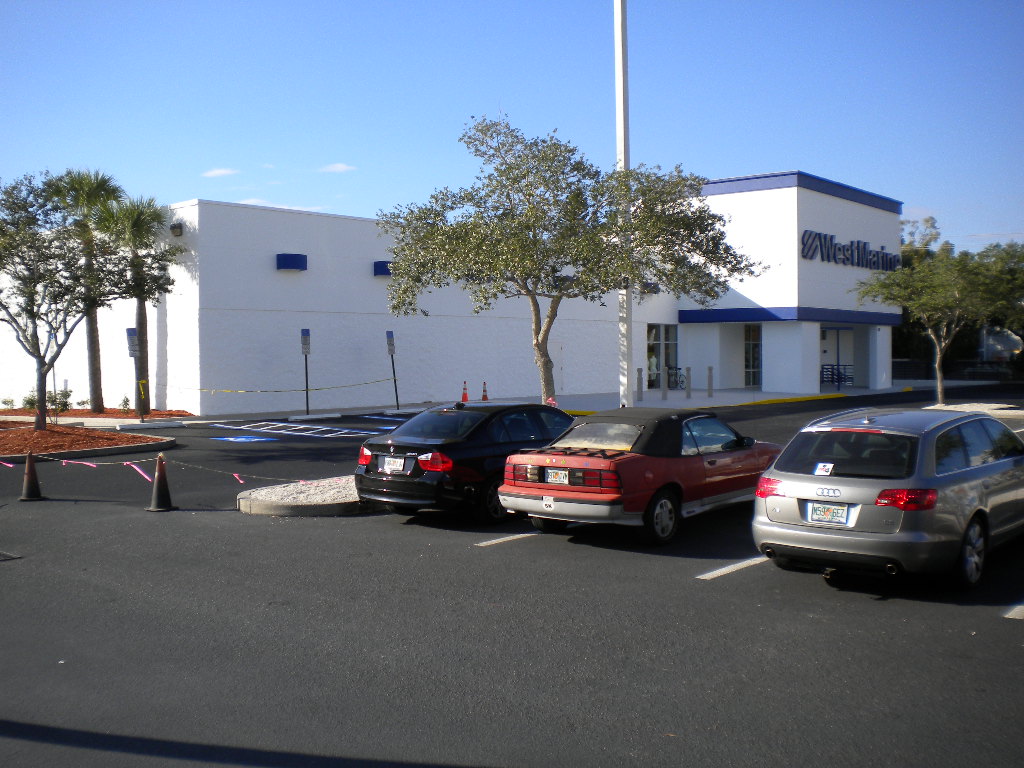
Sarasota gets a new West Marine "Flag Ship" store.

It has taken some time to build, but I have been watching the new West Marine store rising like a Phoenix, from the ashes of a failed retail giant. The building had been hulking empty for about a year, when workers started its make over.


We begin with a cavernous empty shell, and it doesn't take long, before the transformation starts to take shape. Floors are repaired, ceilings drop in places, are painted, and lighting is installed.


Fixture crews appear, along with large trucks, and a store starts to take shape. Every fixture is accompanied by paper work, that describes its layout, for the stock yet to come.


A huge electronics section in the middle of the store is assembled, along with a curved hardtop, that is featuring "top of vessel" electronics, and the Garmin radar array will draw your attention, because it will actually be spinning. 


And the merchandise starts to arrive, and I mean a lot of merchandise arrives. A small army of West Marine staffers spend several weeks stocking the shelves, and putting the final touches on the store. New employees are being trained, and new systems are being put into place. Work is wrapped up on the exterior, and the parking lot gets resurfaced, and re-striped.


The big opening day arrives, and the store gorgeous. More than three times larger than the old stores. The sales floor is 21,000 square feet, and heavily stocked. I'm not sure of the exact amount of items, but I would guess that there are about 15,000 in the store. The breadth of merchandise is impressive, especially in the basic items I buy every day.

The store is also the new west coast of Florida's Port Supply depot. This means, if I need something that isn't in the store (a lot less likely now), it will be available in the store when it opens the next day. On opening day, I was wandering around with a colleague, and he needed two shims for a specific Harken cam cleat, and there they were on the shelf. Odds were, in the old store, they would be in the warehouse, and would have to be shipped in. Not the case with this store.


There is now a very large fishing department, and all of the watercraft, inflatables, and motors are on display.


A full service engine department, to help you keep your motors running, is in the back of the store, and there is a huge apparel department in the front of the store, with new brands, emphasizing West Marine's commitment to women boaters, and my favorite, real changing rooms. 


The end result is terrific, two smaller stores in the area were shuttered, and replaced with an impressive destination store, with a massive inventory, and most importantly, at least to me, is a staggering array of operational marine electronics on display.


Above is my friend Wayne Seel, the general manager of the new Sarasota Flagship store in a moment of exuberance, and he deserves it. Many West Marine employees worked very long hours, for many weeks to make this happen, and it was all worth it. Wayne said, "My vision of what West Marine should be in Sarasota has been fulfilled." Good job Wayne, and West Marine.


Thursday, October 28, 2010

Roadster in the house


I just don't get what the typical go fast boats are all about. Before the owners of these boats start to whip me with their gold chains, I get the "Need for Speed", I just don't get these boats.

I would love to have the "where with all" to own a fast car, and when I say fast, I mean fast as in a Bugatti Veyron, or a Aston Martin DB9. Now imagine what the DB9 would look like if you asked Aston Martin to design one, that would go just as fast, and have room to sleep in it at night, (maybe this would be a good topic for Top Gear), and the typical go fast boat is what you end up with.

So here is my impression when I get on a generic go fast boat. You enter, often precariously, into a cockpit that is generously covered with copious quantities of colorful hides, from the rare Nauga. Stepping down into a cabin designed for Hobbits, onto a purple plush carpet, and with bent knees, and a cricked over neck, you survey the less than expansive space. A galley is to port, with a fridge that will just hold a couple of bottles of wine, and maybe a six pack of beer, and a sink that is just large enough to ice down a bottle of wine. To starboard, is a tiny claustrophobic compartment that has a head, and another pretend sink. Lifting your eyes forward, is a very low white pleather couch, facing a formica cabinet, with lots of mirrors above it, and plenty of gold plastic trim. The "Piece de Resistance", all the way forward is the love nest. A triangular bed, with a leopard print bedspread, that you can barely crawl onto on your hands and knees. With poor access to the bow, often no anchor locker, loud, poor ventilation, and hard riding, they are a classic case of function follows form, with marginal accommodations, and garish interiors. Ouch, quit hitting me with that gold chain, your'e going to break it.

I feel better now that this is off my chest, but all of a sudden, a new go fast boat moves into my town, and all of my perceptions are suddenly changed. The boat below is the new Nortech 80 Roadster. This is a deceptive vessel. At a first glance, it appears to be just 40 feetesque long, but when you get up next to it, it's substantial in scale. With a length of just shy of 80', and a beam of 16', I feel small next to it.


A huge cockpit, and a very commodious European style interior, with a  three cabin layout, that sleeps 6 in comfort. There is a full galley, and en-suite heads for each cabin. It is everything its little brothers from the Jersey Shore want to be, but never achieved. The Roadster has twin Cat ACERT turbocharged diesels providing a total of 3800 HP, powering Arenson surface piercing drives, and reaches speeds of over 70 MPH. With a displacement of 80,000 pounds, and 1200 gallons of fuel, you will get a smooth ride, over a much broader set of sea conditions, and with real range.


Also unlike its little brothers, the helm can hold real navigation systems. In this case there are twin Garmin 5215 15" touchscreen chart plotters, and most clever of all, the Garmin radar dome rises up out of the cockpit on a stainless shaft to a usable height when you need it. So lets sum up, very fast, comfortable, room for real navigation systems in the dash, and a real head turner. I have seen it out on Sarasota Bay at speed, and it an awesome beast to behold. Best of all, no purple plush carpet, and monkey fur to be seen anywhere.

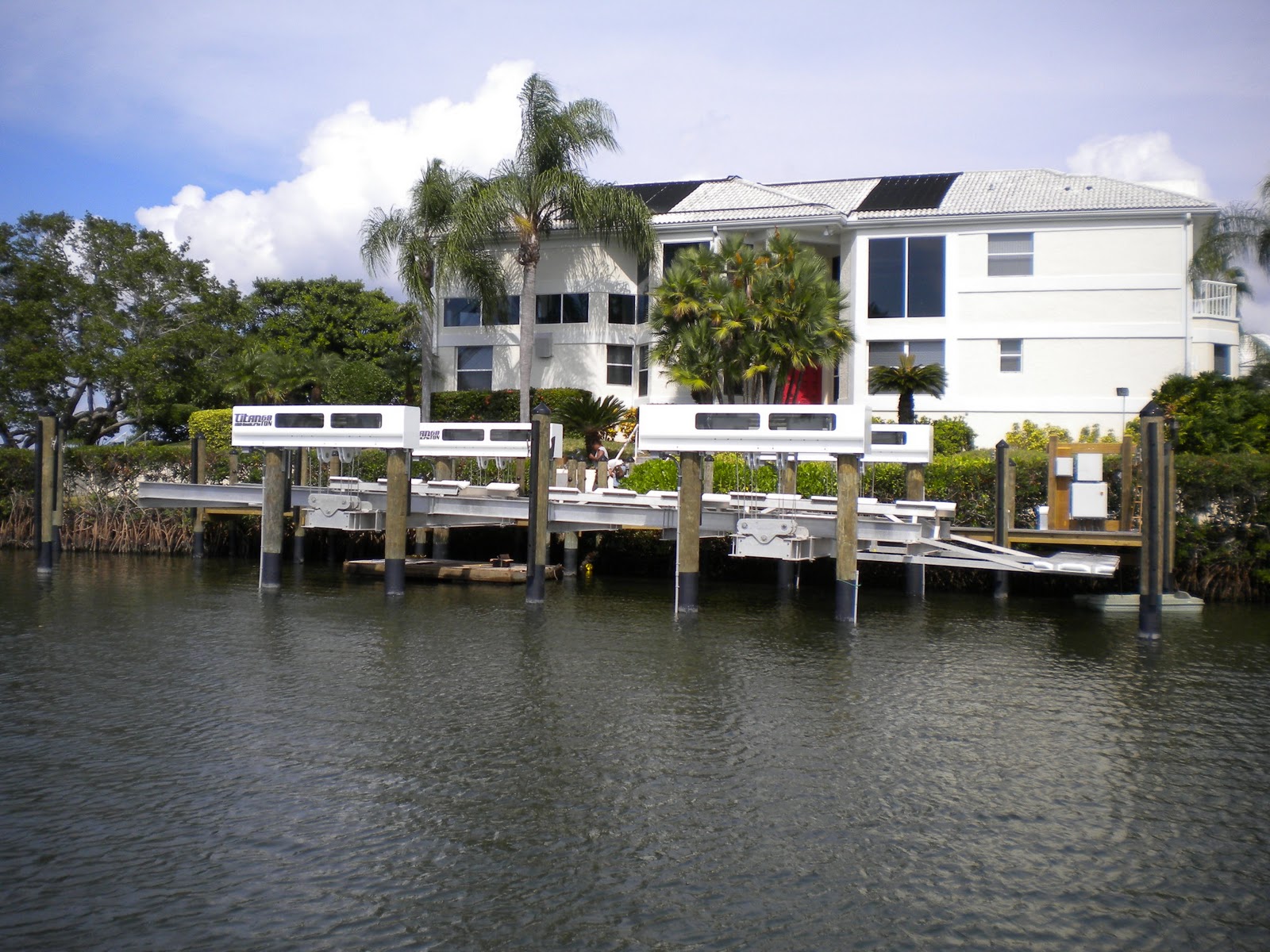
When I took the pictures, I was also very impressed with the lift, and maybe in my slightly weird techie way, I liked the lift more than the boat. The lift is a Titan 60 ton precision machine manufactured by Quality Boat Lifts in Ft Myers Florida. I spoke to Sean, who was the engineer that designed it, and the lift, like the Roadster, is a machine on a grand scale. 


The system uses 220 VAC stainless steel variable frequency electric motors, with cycloidal gearboxes to drive the lifts. With next to no mechanical backlash, the programmable speed controlled system, allows the lift to start smoothly, accelerate to speed, and then gracefully brake to a stop. This type of drive system is also used widely in larger robotic systems. In other words, this lift will place the 80,000 Roadster exactly where it is supposed to be, stop on a dime, and give you nine cents change. The motor covers are powder coated aluminum, and Plexiglas windows on the sides allow you to see the drive systems. In addition to the 60 ton unit, there are also 50 ton, and 36 ton systems, and all are available with a wireless interface, and a remote controls. You need to pick up a big boat? This is where you should go.

The Roadster, has temporarily left town, and can be seen at the Ft Lauderdale boat show, and if I can catch up with the owner, we will come back and take a closer look at this remarkable piece of boating technology.

Now come on now all of you gold chain wearing guys, you know you really want a Roadster, so stop beating me with those chains, the Atocha coins are staring to hurt.

You can see more pictures of the Roadster at Nortech Boats