Showing posts with label Boat. Show all posts

Friday, July 19, 2013

Hurricane preparedness

The lovely, and most aptly named West Marine associate Marina agreed to pose in front of her hand crafted Hurricane preparedness poster. I thought her Vanna White pose was the best of the photos I took. I liked two additional aspects of her art work. The wind flayed captain's boxer shorts are detailed with West Marine logos, and his expression reminds me of Nick Park's Wallace and Gromit claymation characters. Many thanks Marina.


Saturday, March 16, 2013

The FEMA project

Thanks for coming everyone. Our beloved president of Magnifico Yachts, Mr Grunion has asked me to do an update for the engineering team on our two FEMA programs. Our first program is to find out if our yachts can be built to meet FEMA hurricane standards. This has turned out to be little more difficult than we thought due to the impact testing requirements.

We did get a good deal on the air cannon we bought in a government surplus auction, and finally got it installed in the old mold shop out back. That's the good news. The bad news is that it took a little time to learn how to use it.

Staff went out to marine salvage companies, and collected a broad range of stuff that might blow around in a marina during a hurricane. We got lots things like beer coolers, sub-woofers, flag poles, daiquiri blenders, and that sort of boaty stuff. For the first test, we set up one of our hulls about 100' in front of the cannon, and loaded it with a LORAN unit. The purchasing department had bought a lot of them on sale off Ebay before they realized the system had been shut down two years earlier.


Tuesday, December 11, 2012

Experimenting with Bob the navigator

I'm feeling not so smart. By that I mean not as smart as a 16 year old kid. I know a lot, but it has become apparent that being intuitive in today's world takes some real effort. I barely survived the changes in Facebook, I do have a Twitter account, but have never tweeted. But today I am a winner, even though I only get a small red ribbon.

After mucking around I have finally gotten a video to work right. I kept reading about embedding videos, and with my tedious Blogger software, it just won't work. There is a little insert video button on my toolbar. But because my Internet connection is slow, it always opened with just a button that said upload video. Had I been a little more patient additional lines would have appeared say from You Tube? My You Tube? My Cam? Phone?...... As I said I should have asked a kid first. So here is belatedly the first appearance  of a properly installed video on MIR.


This little piece is a rainy day experiment. I have been looking for old public domain archival materiels related to boating, with the idea It could be edited for some other more insidious purposes. It's harder that it looks. These excerpts are from a Navy navigation training film circa 1943 titled "Night Piloting.". Out of 17 minutes of excruciatingly tedious and pedantic film, I salvaged just about two minutes.

I was intrigued because it dealt with navigation techniques that are now 70 years old, but still applicable today, sort of. It didn't turn out exactly like I thought it might, but this is often the way a lot of my projects end up. I had footage, I arranged it into an order, and then made up the dialog. It ended up being a oddly twisted version of a morality play. So no Oscar, but a lot of education in editing, and locating the material.

Here is the link to the original "Night Piloting"


Sunday, January 29, 2012

It's golden

Kate and I watched the new Fox show Touch the other day. It's about an autistic kid who can see patterns. He spends a lot of time writing stings of numbers in a book, and some of the numbers are darker. When the camera pans back you can see the darker numbers are describing a spiral. Wait a minute, I know these numbers, and then remembered a conversation from years ago I had with an architect friend Jack Whelan about the golden rectangle, and boat shapes. So after the show, I gave myself a refresher course in the golden ratio, and you're going to be the beneficiary of my relearned information. 

In a burst of enthusiasm I start to Google boat images that might fit well into a "Golden" based story, and I spotted the boat below. I looked at it for a moment, and suddenly realized I know this boat. This is Gizmo, Ben Ellison's boat, and he took the picture. To my eye it looked golden. How I did I know it's Gizmo? Who else do you know that has a boat with four radars. I did a quick cut, paste, and little geometry 101, and decided this is good choice for the story. I emailed Ben and asked, "Could I use his picture in the story?" He asked if Gizmo "was golden", I said "very",  Ben said, "cool", and here we are.


Friday, November 11, 2011

KVH M1 101

Marinas and yacht clubs are slowly learning that providing some sort of dockside cable television service to their customers is getting increasingly more difficult, and complex. The switch to digital cable systems more than ever before, now requires a digital receiver box to be installed in a home, or boat for each television. But short of tornadoes, landslides, or sink holes in Florida, your house doesn't typically travel, your boat does. The equipment cable providers give you is based on a home installation scenario. You know the type, you can get behind your TV and plug and play all of the cables, in air conditioning, without sweating or bleeding. On a boat this is much different.

A local yacht club is discovering how painful this is becoming. Their Comcast system now requires digital tuner boxes for each television to receive the channels. That's not quite the truth, the first 24 channels of very basic cable is still available for now, but for most cable TV suppliers a box of some sort is required. So here is the catch, if you install your local vendors box in your boat, and you travel to another marina with another cable TV vendor, your box won't work with their system. This problem is going to get worse, and never better. I do have a suggestion for marinas. With a good quality digital on air antenna, and an amplifier system you could provide in most urban areas 20, to 30 or more digital high quality free local channels to your boaters. The capital cost is low, and you can get rid of those costly cable TV bills.

A good option for boaters that cruise, and who want broad channel options is a satellite marine TV system such as the KVH M1 seen below.


Saturday, October 2, 2010

A straightened out Elite Craft, part 2

It was a lovely Friday morning, and Sandy called me to go play on Sarasota Bay with the new trim tabs on the Elite Craft. It really is a beautiful boat, wood-esque appearing, without the the struggle of maintaining real wood, and boy does it turn heads when your'e out on the water.

As the fork truck was taking the boat to the water, I snapped a shot of her undersides. She has a moderate vee hull entry at the bow that carries back, and transitions into a small flat pad aft at the rudder, and prop. With no hull strakes, I sensed that it could be a little slippery in the water, and why the back end might have a tendency to slide out doing aggressive turns, or while encountering larger boat wakes. She runs bow high until planning off, and then the bow drops, and she flattens right out. One of Sandy's complaints was when planning flat in a light chop, you get spray over the bow, and I experienced some of this during our excursion. It also has a bit of a bottom slapping feel when crossing larger boat wakes at speed, but the comfortable, and thick cushions take some of the sting out of this.
The tabs worked very well, and the ability to pick up the bow a bit in a moderate chop dramatically reduced the amount of spray that came over the bow. 
So at this point, since I have not had the opportunity to ride in the boat prior to the trim tab installation, here are Sandy's comments:

"The handling is much more stable! Turning feels more solid, and predictable, and the boat just seems to resist tilting over anymore. You really have to move some weight around now and then only one or two clicks corrects it, and holds it. It no longer swaps lanes in the ICW when encountering wakes. Rather now it stays the course and holds its heading much better. You can scrub off speed just like an I/O, and you feel her dry off, pick up rpms, and move out steadily under high speed as the tabs are lifted. Pretty hard to achieve without the tabs, more like "impossible".

"The boat is much dryer, (which is not easy to accomplish) and overall a pleasure to drive now, whereas before I was considering not keeping it. Now she runs as good as she looks, and it feels like a 20 foot plus boat. I am ecstatically happy with her now! I am scrapping the big block idea in favor of a seriously warmed over small block, for simplicity and weight, cooling etc.. and now I think she take a few more mph with ease."

Even though I had not experienced the boat prior to the trim tab installation, the boat felt good to me. We did a couple of very sharp high speed (25 kts) turns, and the back end felt very stable. I also suspect that the additional outboard support given by the tabs, made the boat a little more stable, especially at speed. It's such a pretty boat, I want one. 

Saturday, September 18, 2010

Meet Steve Padar

One of the most important lessons I have learned in life, is that everyone has a interesting story, if you stop talking yourself long enough to listen, and boaters always seem to have more interesting stories than most. This is the first, of a intermittent series of stories about some of my clients.

So let's go meet Steve Padar. This is Steve's backyard, and his boats. He has, a small Scout center console, and in the background, his Grady White walk around. He had a third boat on blocks in the back yard, but I suspect in order to maintain martial bliss, he was advise of the right answer to the question of "When is that boat leaving the yard?", and it is now gone. Do you see that rounded structure to the right, that is a telescope dome. I met Steve when he requested a little help with installing a Raymarine weather receiver for the Grady White, although he was more than technically capable of doing this himself. 


When I first visited Steve's house, and while walking up to the front door, my keen powers of observation told me there is something different about this house.


And also in his backyard, you quickly develop the opinion, that Steve is doing something more than trying to receive blacked out football games on the sly.


So here is Dr. Steve Padar, from Sarasota Florida, who in real life is a practicing neurosurgeon, and he graciously allowed me to see his metaphorical man cave, and what a technological wonder it is! 


Everywhere you look, there is something to see. A full wall of floor to ceiling books, and racks of equipment everywhere. Behind this equipment wall is a long desk with two very large flat screen monitors, and a half dozen computers under it.


Another large desk is packed with lots of ham radio gear.


Wiring galore everywhere. These bundles are the feeds from the exterior antennas. 


And lots of Ethernet connections tying systems together.


So what is this room all about? In addition to being a ham radio enthusiast, one of several of Steve's hobbies is the acquisition, and direct down loading of weather photographs from NOAA's satellites, and this is not a trivial task. The pictures below are from the GOES 12, and 13 satellites. These are geostationary  satellites parked over the equator at 75 degrees W (GOES 13), and 60 W (GOES 12), and they were being downloaded as I watched.  


These photos were downloaded on Sunday, September 5th around noon EST. In the full frame picture, you can see hurricane Igor, and behind it, you can see the tropical depression, that will become hurricane Julia. My camera does not do the quality of these pictures justice.


Above is a better view from GOES 12. You can see Igor clearly, and Julia to be, is just off the African coast. Although it takes substantial technical acumen to receive these photos from a geostationary satellite, Steve's equipment can also receive photos from weather satellites moving in orbit. This takes another level of technology. You need software that will provide you with Mr. Kepler's orbital data predictions, the antenna axes kinematics have to be programmed to intercept the track, and match it. The satellite signal has to be programmed into the system to receive the signal, and if this wasn't enough, as the satellite approaches you, and then moves away, the signal undergoes a Doppler effect that shifts the frequency, and the receiver has to compensate for this shift. This is a very simplified explanation of a very complex process.

Steve's equipment can receive frequencies from 50 kilohertz to 2.4 Gigahertz, although to be technically correct, he can't receive every frequency in this range, but he does handle a good swath of it. Amazing, and technologically stunning to say the least, and all of this hidden in plain sight in a lovely bay front home. 

We're not through yet. As if this wasn't enough, Steve's other hobbies are travel, boating, diving, and photography, and he excels at all four. He has traveled all over the world with his camera, from the Antarctic peninsula, to the North Pole and many locations in between. Diving in Truk lagoon, the Galapagos Islands, the Australian Great Barrier Reef, and many other exotic locations, and taking magnificent photos along the way.

I mentioned that Steve visited the North Pole, something that most of us will never do. He traveled there on the Russian icebreaker the I/B Yamal. This is the pride of the Russian icebreaker fleet. It is just shy of five hundred feet long, and is powered by not one, but two nuclear reactors, and weighs nearly one million pounds. This ship will crunch some real ice, and real ice had to be crunched to get to the pole. Only about a dozen trips by ship have ever been made.

As a footnote to the story, I was looking for a picture of the I/B Yamal, and you are looking at it above. The picture was taken Aug 3rd, 2001 while in route to the North Pole. In the picture, of the not easy to get certificate below, there are three notable things about it. The location is 90 degrees north, you can only get it if you have been swimming at the North Pole, and it is dated August 5th 2001. So Steve is actually on the I/B Yamal at the time the picture was taken. 


Now you have met Steve, doctor, neurosurgeon, boater, traveler, photographer, diver, and intensely curious about the world around him. I know he will demur, but he is a modern day renaissance man, and an extraordinary, and gracious person to spend time with. All of us have a bucket list. I think Steve's bucket is really a fifty five gallon drum and still mostly full. I am working on being a better listener, and thank you very much Steve for the time you spent with me, it was most enlightening, and pleasurable.  

You can see some of Steve's terrific photography here. You may need to download the Photodex.com viewer to see the shows. Check out the Antarctica, and Truk Lagoon slide shows, but there is much more to enjoy here.

You can learn more about the Ice Breaker Yamal here.

The Photograph of the I/B Yamal is from Wikipedia commons, and was taken by Wolfratz

Monday, August 16, 2010

That fish box is strong enough, most of these guys just use them to keep the beer cold anyway.


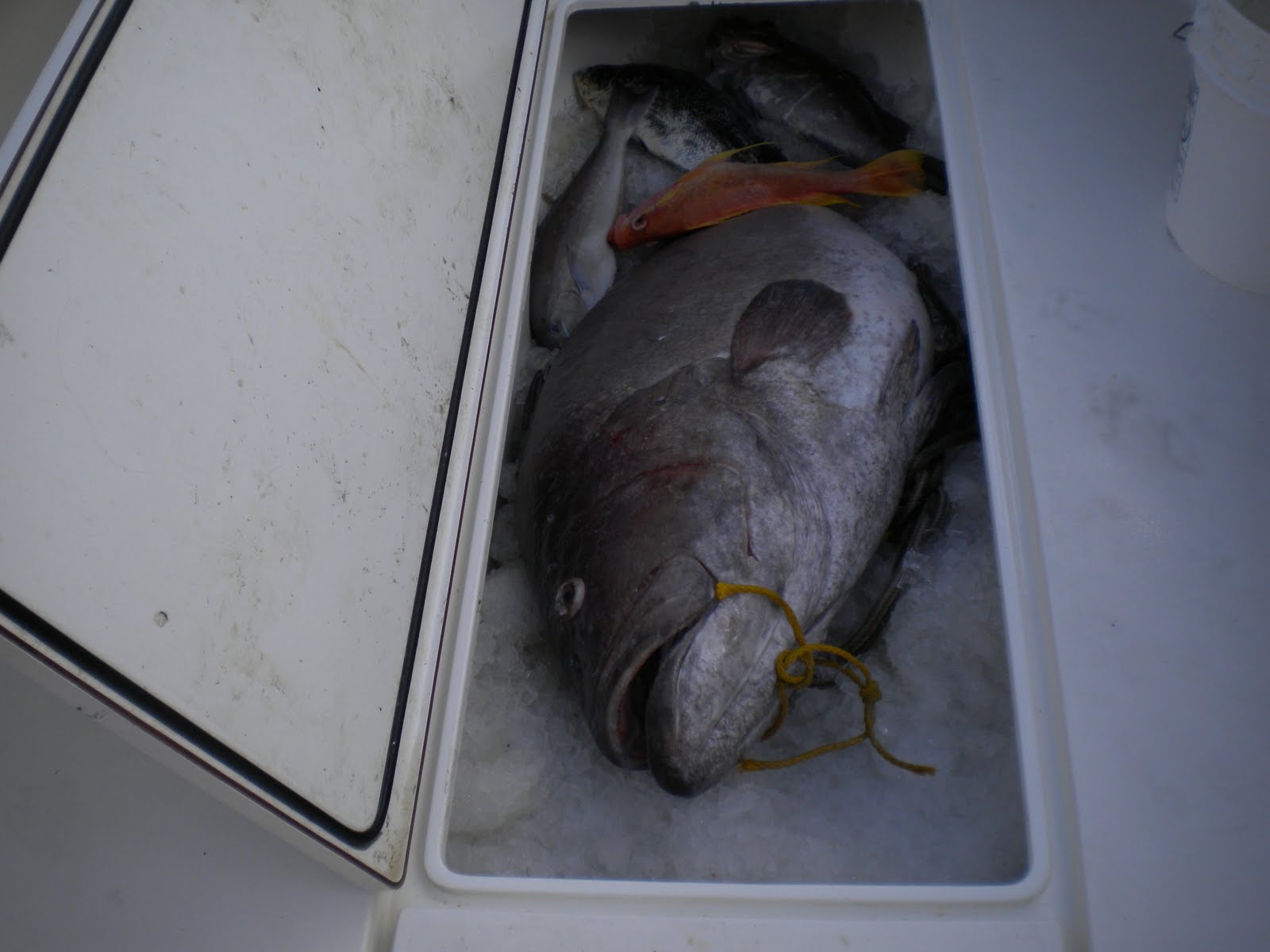
Nothing better than a good fish story, especially when the fish is so big, you can't spread your hands wide enough to show people how big it really is. The fish is a Warsaw grouper (hence forth referred to as Gigantor), caught in about 650' of water about 140 miles off the coast of Sarasota, and the best guess is that it exceeds 200 lbs. It took three people just to get it into the boat, and as you can see, it dominates a 6' fish box. I will add the actual weight in the comments box, when I get it later today. 


The boat is a popular, and higher end center console fish boat, and in general, is a well constructed vessel. The owner loves to fish, I mean really loves to fish, and he does a lot of tournaments. The boat is crammed full with fishing gear, coolers, lot of extra gas containers, and bean bag chairs for over night expeditions.


So enough of Gigantor, see that black crack in the picture below, at the edge of the fish box? That is not where the fish box should be. The back of the box has fallen down about three inches, and now water, and or ice can slosh out of the back end of the box into an area, I suspect was not supposed to have water at all.


It was hard to tell exactly what had happened, because the box had Gigantor the grouper in it, and numerous spectators were hovering around, but the aft center of the box didn't appear to have anything fastening it.


The box seems at first blush, to have been just tabbed with fiberglass in the corners, and under the weight of the fish, and ice, the tabs just failed. The seas were calm, so I ruled out the fact that pounding in 4' seas, with Gigantor in the box could have exacerbated the problem. The attachment was just not adequate, and you can see the torn fiberglass in the corner below. Bad design? Bad manufacturing? I don't know, but this builder can do better than this. The repair will be interesting, because all of the fish box installation was done prior to installation of the deck. I'm sure that this builder will take care of the problem, but it shouldn't have happened in the first place. If you want real fishermen to buy the boat, the fish box has to be able to support real fish. Gigantor has had the last laugh as payback for his untimely demise, and all the beer was kept in real coolers.


Just as a side note, I will amend this blog tomorrow with a couple additional photos of the grouper on the scales. The final measured weight is 206 lbs. It is worthy of the name "Gigantor", and boy did it produce some fillets.


Jason Boyll, from the fishing team" Get'n After It!" emailed me a picture of Gigantor hanging on the scales in Cortez Fl. It is impressive, and these guys are are fishing monsters.


Thursday, July 1, 2010

Burnt offerings

These are two intertwined musings about melting electronics, and access to put out a fire. Below is a controller for a marine device, that was installed at the boat builder's plant. It was located inside the console, along with almost everything else on this boat that was electrical in nature. It was installed according to the manufacturers wiring diagram, and instructions, with the correct wire gauges being used, and as far as I could tell, the installation of this little black box was done to all current standards. I strongly suspect, that in a blackish grey sort of way,  that it is no longer operational, since it seems to have caught on fire.


As you can discern below, the wiring harness is fine, and shows no evidence of damage. The box appears to have had some sort of a internal melt down that caused the fire, with out tripping the fuse. It wouldn't be appearing here, if I hadn't seen another slightly different control box from the same company slag down in a like manner. In both cases, it is likely, if they were left unattended, a real fire could have well occurred. 


In the case of the box above, the owner, while underway noted black smoke coming out of the console, and knew where his fire extinguisher was. It was fully charged, and its contents were quickly emptied into the console's interior. The smoke stopped, and the boat returned to port. Things were done quickly enough, that, short of cleaning up the mess the fire extinguisher made inside the console, there was no other damage, short of the burnt offerings you see here.

A similar (in function) box I installed, had the same thing happened also, but I was there at the time, and removed it, albeit not gracefully, but quickly from the boat. It didn't look quite bad as the one above, but in few more minutes it would have. I think twice is not the charm, and I am concerned about the amount of power that these boxes control, in such a small package. Maybe stuff happens, or maybe there should be some design improvements to make things more robust. I also found some additional comments online about this issue.

Although the story ends well, and nobody had their eye shot out, it led me to musing about access to console interiors, and asking myself the question, "Have I seen boats where access to the console interiors is difficult?" The answer is yes, many times. A fire can occur in many places on a boat, but an electrical fire is statistically  more likely to happen in a place where most of the wiring is, and on many boats, the consoles are one of those areas.

In the case of this boat, there were several ways to get quick access, and a front access hatch was used. But I have been on many boats, where if a fire occurred in the console, it would take time and tools to get to a point where you could use a fire extinguisher to put out a fire, and maybe, by then it would be late.

I was in my local West Marine store, and I told my friend Wayne Seel (Store 63 Manager) about this story I was assembling, and I asked him if I could look at the Beckson-esque deck plates to get some ideas for console access for a fire extinguisher. Wayne got all excited, and said "follow me", I have exactly what you need. Down the aisle we went, and "Lo and Behold" he produced this thing called a Fire Port, made by Marine East. What a nifty gadget this is. A quick hole saw cut, and you have instant access for a fire extinguisher anywhere. It's about 3" in diameter, and is reasonably resistant to water access, and inexpensive. The clear window allows you to see into the area, before you do anything abruptly, and it won't let a lot of oxygen into the area when you push the fire extinguisher nozzle through the port. What a great idea, thanks Wayne, you know your inventory, and you can teach this old dog something.


So the next time you go on board your boat, think about this little story, and see if you could put out a fire inside the console, or other locations. Then find your fire extinguisher (I think it  is under the console cover inside the head, or maybe I put it under the seat somewhere), and make sure its  little needle points to the happy green color. Remember that Darwin always culls the weak and infirm from the herd.

Saturday, June 19, 2010

Bob and Carol visit the Gulf of Mexico oil slick, an unfortunate series of events occur.


Bob and Carol were watching their favorite news channel, and listening to stories that were saying the oil slick wasn't that bad, and drilling for oil was "Good for America". We remember this insensitive, and not so bright couple, Bob, and Carol from the story about buying their new boat. So Bob, in a very rare display of initiative, tells Carol, "lets load up the boat, and go out and see what this oil slick business is all about". Bob, Carol, and the kids make sure they have all of their important marine gear. The kids grab Ipods, and video games, Carol makes sure there are plenty of chips, and dip on board, Bob gets a back up case of beer, and off they go on their Magnifico 50' yacht. It doesn't take long for Bob and Carol to see the first signs of the slick from the bridge. Bob says "this isn't that bad", and Carol says, "look at the pretty colors, but it does smell a little funny".


Bob and Carol, comforted by the fact that things don't seem that bad at all, carry on. Bob wants to see where the oil leak is, because he saw on TV cool pictures of things burning there, just like it was the Fourth of July. After a while, the kids emerge from the dark cool cabin complaining that it was getting a little warm. Bob says "well stay out here in the fresh air, it will do you some good". The kids wrinkle their nose at the odor, and disappear back below. Bob yells out after them, "just turn the thermostat down". Bob thinks about this for a few milliseconds, and decides the strainers haven't been cleaned for a while, and he will have his boat maintenance guy check it when they get back.


Bob is watching his favorite TV news show, on his chartplotter thingy, and isn't paying attention to the engine gauges. The temperature gauges, on both engines have started to climb slowly up. Bob asks Carol to get him another beer. Just as Carol hands him a new cold one, Bob feels a thump, and the generator shuts down. Seconds later the port engine shuts down, and alarms start squealing on the bridge. A moment later the other engine shuts down, in conjunction with a very loud clanking noise. Carol says "Stop all that high pitched noise, I'm trying to read my Cosmo". Bob turns off the engine ignition switches, and all of the alarms stop, except one. Bob frantically scans all of the gadgets on the bridge, and sees an outline of his boat, with lots of little red lights on it. The one that is lit, is marked "High Water Alarm". The kids come running up to the bridge screaming, "the floor is wet in our cabin". Bob runs down, looks into the companion way, and sees two inches of water over the carpet in the forward cabin. He also smells some exhaust fumes in the cabin.

Bob now has an inkling there may be a real problem now, and he should get some help. For the first time on the trip, he turns on the VHF radio, and starts to yell "Mayday, Mayday". The Coast Guard answers, and starts to ask questions. One of the questions is, "where are you?". It takes Bob some time to figure how to get the TV off of the chartplotter thingy, and get it on a chart page with his position. He tells them the position, and seconds later, all power on the boat disappears. Bob thinks maybe they need those orange floating jacket things, but he doesn't know where they are, and besides, Carol wouldn't get into that black greasy water anyway. One of the kids suggests that the raft in a fiberglass box behind them would be useful. They all rush to the back of the bridge and stare at it. A cord is spotted, and one of the kids jerks it, and it explodes open just in time. The water is now at the bridge, and they all pile into the orange raft, just as the vessel gracefully sinks away underneath them through the thick black goo.


A helicopter shows up, and Bob, Carol, and the kids, are saved, but the Magnifico 50' yacht has now been added to Bob's "Museum of Shattered Dreams" vast collection.

This scenario is possible, although most likely not as Bob and Carol experienced it. I'm not going to turn this into a science fair project, but I will  layout in general terms what is in the oil slick, and what impact it could have on your boat, should you encounter it. I will also add some links for further discovery, if you are so inclined.

The goop in the water can be generically described as "Sweet Louisiana Crude" A crude oil is described as "Sweet", if it has less than .05% sulfur content. Crude oil is a hydrocarbon soup, that is processed into fuels (gasoline), solvents, and many other products. In its raw form, there are many materials naturally present such as Butane, Methane, Ethane, and many more "ane's" are on this list. All of these hydrocarbons can attack, and damage materials that are not designed to withstand contact with them.

So what does this have to do with with your boat. The chemicals present in the oil slick can attack gasket materials, and hoses that are not specifically designed to resist these hydrocarbons. Go to West Marine, and check out the cost differential between 10 feet of fuel line hose, and 10 feet of water line hose. There is a huge difference in price (400%), because materials designed to withstand degradation from hydrocarbons are much more costly to manufacture.

In Bob and Carol's case, I blamed the air conditioning system for sinking the boat, although I can certainly add many additional contributing causes. As the AC cooling water was pulled into the boat, the oil in it started to stick to the strainer basket, slowing the water flow, and hence the less cooling. The oil caused the raw water pump impeller to soften, and the hoses attached to the pump softened as well, and started to swell. With enough time, and pressure, the softened hose from the AC pump burst open, and the system starts to pump oily raw water into the bilge. This would run for a while, until the AC systems start to shut down, due to slow water flow, and the relays automatically turn off the pump. But by now the damaged impeller allows water to bypass it, and water still flows, but at a slower pace.

The generator suffered from a similar scenario, but in this case, the strainer just got plugged up with oil, and it did a high temperature shut down. It survives this time, but the entire cooling system will have to be flushed out, and the impeller replaced, at the minimum. This could be lot worse, depending on the type of cooling system it had.

I didn't talk about the head system, but if salt water was used for flushing, the oil can eat , or damage gaskets such as the joker valve, and hoses.You should also hope that manual heads had a vented loop above the water line, or this could have sunk the boat just as easily.

Now for the engines. In almost all cases, oil in the cooling water can go from just plugging things up, causing shutdowns, to destroying the engines. This goes for gas, diesel, and don't forget outboards. There are a myriad of scenarios here. In Bob's case, remember he smelled exhaust gas in the cabin? It could have come from a failed rubber exhaust elbow, that oil laden cooling water was passing through. It's tough enough job to keep cooling water away from the insides of engines, and transmissions with out worrying about all the gaskets that do that job, failing because of hydrocarbon degradation.

Can it get worse? Sure it can. How about coating your zincs with a nice thick film of oil, rendering them useless. Your ground plate for the single side band radio will also suffer the same fate. The pretty vinyl boot stripe won't like the oil, the hull can stain, and how about the water lubricated dripless stuffing boxes. I'm not sure, but I suspect cutlass bearings most likely won't like the oil either. The list here is almost endless. It's hard enough to keep a boat operating in a highly corrosive salt water environment. Add this nasty hydrocarbon goo to the mix, and you will really shorten your vessels life, and spend a lot of extra money. Did I mention the potential for a fire? A burst hose, or failed gasket spraying crude oil laden water inside a hot engine compartment, does not bode well if an ignition source was available.

The birds, and marine life aren't surviving it, and your pleasure boat won't either!


If you go down into the oil today
You're sure of a big surprise.
If you go down in the oil today
Your boat better be in disguise.

For ev'ry skimmer that ever there was
Will gather there for certain, because
Today's the day the BP Oil has their picnic

.
(With apologies  to Mr. Hall for stepping on "The Teddy's Bear's Picnic)


Want to help? Here are some sources
What is crude oil, and what's in it.

Bill Bishop


A small postscript about the story.


I received a flurry of comments today after I posted this. They range from they liked the beginning, but not the technical end, they  hated the beginning, but liked the technical end, they liked it, and they hated it, it was too political, it will discourage boating, and it just made some people uncomfortable. I have fooled around with this story on and off today. It is what it is, and it will now stay this way.


This is a simple story. Bob and Carol, are the foils. They are the Eddie Haskell's of the world, and provide the set up for a general discussion of how the oil slick could affect a vessel. If the subject matter makes people uncomfortable, I'm ok with this, it should. I live In Sarasota Florida, a place with world renowned beaches, and a community whose primary income depends on these pristine beaches, boating, and fishing. It is also a community in denial. No task forces are looking into what to do if the oil gets to us. No planning is going on. We are advertising the fact that we don't have a problem, come visit, but no one is looking forward into the future, and we should be.


Tens of millions gallons have already spilled into the Gulf, and if you accept the the more conservative number of 35,000 barrels a day now being released into the Gulf. Thats 42 gallons in a barrel * 35,000 barrels = 1,470,000 gallons per day (NOAA estimate). Now lets just assume that the relief wells won't cap this problem until mid August, lets say 60 more days. The total gallons of crude oil released just over the next 60 days would be 88,600,000 gallons, or around ten times the Exxon Valdez spill. We can argue about the numbers, but they are staggering at any level. Now if you don't think this problem is going to impact Sarasota, and communities in the down stream flow of the Gulf Stream, including the eastern US coasts, you must have your head in the sand. Just ask someone from the coastal areas of Louisiana, what life is like now. Was it a bit political, yes. Did I try to make it a bit pointed, yes. Did it make you a little uncomfortable, I hope so. "


"We have met the enemy, and it is us". Walt Kelly.


Bill 


Monday, April 12, 2010

Stochastic analysis of navigation systems single point failures, you just can't easily always find out what is broken.

The headline is meant to say, that even if you're smart, sometimes you just don't always have good tools to definitively say, this is what's wrong. As a case in point, I often get cases of "no depth is showing on my what ever device".  So this is where playing the odds comes in. If you call the sounder tech support group, they always tell me two things. The first is try another transducer, to which I say " I don't have one of every transducer laying around, so what's plan B. The tech says, "well I don't know, because it is usually the transducer, and not our equipment". I say thanks, and hang up. What I don't do is call Airmar to see what they think, because it is a very rare occasion the transducer is bad. So the solution to the problem is to rip the sounder/module out and ship it in for repair. Lo and behold, ten days later the unit is back, I plug it in, the system works, and it's another Christmas miracle. The real problem is that without some expensive, and exotic equipment, or a box full of transducers, there is no real way to tell which is DOA. You use your instinct, and experience to find the least costly solution for the client.

Sometimes, but not often, the wrathful odds gods do not favor you. That's me below, starting off on what turned out to be about three hours in the dreaded bosun's chair. I wish there was a more comfortable admirals chair. This starts with a radar which had worked for five and a half years, suddenly ceasing to work (scanner not responding). This message tells me we have a failure to communicate going on. Now who is not talking to whom? Is the radar not talking? Is the display not listening, or is the cable bad? My sense of the odds here are that the radar dome is the most likely suspect (it lives outside), followed by the display, and then the cable. 

So up the mast I go assisted by the owner, his broker, and some other local club members helping, and watching the show. I pop the dome cover, and it is clean as whistle inside. I check the power, and it is good. I pull the data connector and it is also fine. My assistant was off on another job, so I didn't have the capability to wring out the cable on the spot with the available crew. Besides the cable had been fine for five and a half years, and there was no evidence of damage, or splices in the cable. So I decide to pull the dome, and ship it for repair. 

The radar is a big package, and I ship it ground to save some bucks. A few days later, the boat sells, and now everybody wants it done yesterday. I instruct the vendor that we will pay a $50.00 expediting fee, and in a couple of days I get a call from the tech saying there is no problem with the dome.  Shoot, so I toss the dice and send the display in to be checked out with the dome. The tech calls back, and tells me "so sad, too bad" they're both good. So like Sherlock Holmes says" When everything else has been eliminated, what's left, however unlikely, is what it must be". 


Before I'm chided for not checking the cable, I want to point out, in my opinion, that it takes three people at the minimum to go up the mast. My butt in the chair is one, somebody manages the winch, and a third to handle the safety line. It's cheaper to send the module off, and have it checked. If the module was bad, job done, if not, it's the cable. So on a dreary Sunday morning, a crew of four assembles. I go up the mast, and attach the pull line, and the cable comes out, and a new cable is pulled in. The dome goes back on, the display is re-installed, and it all works. While we are there, a spreader bulb is replaced, and I get a good view of the marina from the top of the mast while I straighten out a windex.

Well, as you have now surmised, it was the cable. In the picture below you can see a series of cuts, caused by the conduit pipe at the bottom of the mast. Who ever installed it, got a little rough on the haul up. Given the depth of the cuts, and the amount of exposed copper, I'm amazed it worked at all, much less for over five years. Most of the time, I can tell you exactly what's wrong, but sometimes you just have to roll the dice."Are you feeling lucky today?"